The biggest threat to PDX Home Prices

It’s not what you think.

We have to hope that the procrastination of the Hanford cleanup doesn’t kill us all.  Our home values would be the least of our concerns.

It’s really true there’s no free lunch.  Yes, the United States beat Russia in the race to develop the first nuclear bomb.  There are many books on the subject and The Manhattan Project was one of the most ambitious undertakings in the 240 year history of this country in size and scale.

The downside is, we’ve been trying to clean up the site for over 70 years and are nowhere near complete.  Current estimates are $2 billion per year until cleanup is complete in 2050.

There are 53 million gallons of radioactive waste in stored in 177 underground tanks.  One third of these tanks are leaking radioactive waste into the soil and groundwater.  Aquifers are containing 270 billion gallons of contaminated groundwater. As of 2008, 1 million gallons of radioactive waste was traveling through the groundwater toward the Columbia River.

I don’t know about you, but that makes me lean towards Alaskan Salmon at the seafood counter.

From a recent article comparing the risk of Hanford to what happened in Fukushima, Japan.

On 29 September 1957 a tank containing waste similar to the waste in the Hanford Tank Farms exploded at the Mayak plutonium production site in the former Soviet Union, known as the Kyshtym Disaster. The cooling system for one of the tanks at the Mayak site failed and the temperature inside the tank rose eventually causing a chemical explosion that sent a radioactive cloud for over 350 km downwind and heavily contaminated an area near the plant with catastrophic levels of cesium-137 and strontium-90. This was one of the worst radiological disasters in human history at the time, and remained so, along with the fire three weeks later inside a nuclear reactor core at the Windscale facility (now called Sellafield) in Cumbria in the United Kingdom, until the Chernobyl meltdown and explosion in 1987. The Kyshtym Disaster, which a Soviet study concluded resulted directly in 8,000 deaths (not to mention illnesses) was the consequence of an explosion in one tank. At Hanford there are currently 177 such tanks, each containing similar disastrous potential, and located beside one another.

If you do the math on the population of people downwind, all I can say is we’d better hope those cooling systems continue to work or this place will be uninhabitable for a century.  And that’s just one scenario.

I’m anxiously awaiting the Trump administration to roll out its infrastructure plan.  Rumor has it a small, private outfit in Montana with connections to Ivanka Trump’s wedding planner will be put in charge of the cleanup.  If that happens, I’m moving.

The Fog of War

In 2003, a documentary titled The Fog of War: Eleven Lessons from the life of Robert S. McNamara was introduced.  Here’s a link to a 2 minute trailer on it.

The reason this movie comes to the forefront of my mind these days has to do with the banter going back and forth between the U.S. and North Korea and Iran.

In the movie itself, McNamara was interviewed where he talked about the discussions of the Kennedy administration cabinet, strategizing around the Cuban Missile Crisis.  The most revealing aspect of the interview was the fact that much of the strategy conversations had to do with ‘guessing’ at what Russia and Cuba were thinking.  What their motives were.  They didn’t know for sure so they had to guess.

McNamara’s point was, had they guessed wrong, they could have a nuclear event on their hands that was a result of a big misunderstanding.  It was entirely possible for this to happen.  He strongly emphasized the need for diplomacy so that any events centered around war were fully understood and not the result of second guessing wrong.

This is perhaps the scariest aspect of the Trump Administration for me.  The probability that he will initiate military action based on his impulses without a full understanding seems extraordinarily high.  This is why level-headedness matters in the oval office.

It looks to me like the movie is available from Netflix but on DVD only.  There may well be other streaming sources.  If you get a chance to see it, I found it very enlightening.

Below is a summary of the 11 lessons from McNamara.

  1. We misjudged then — and we have since — the geopolitical intentions of our adversaries … and we exaggerated the dangers to the United States of their actions.
  2. We viewed the people and leaders of South Vietnam in terms of our own experience … We totally misjudged the political forces within the country.
  3. We underestimated the power of nationalism to motivate people to fight and die for their beliefs and values.
  4. Our misjudgments of friend and foe, alike, reflected our profound ignorance of the history, culture, and politics of the people in the area, and the personalities and habits of their leaders.
  5. We failed then — and have since — to recognize the limitations of modern, high-technology military equipment, forces, and doctrine. We failed, as well, to adapt our military tactics to the task of winning the hearts and minds of people from a totally different culture.
  6. We failed to draw Congress and the American people into a full and frank discussion and debate of the pros and cons of a large-scale military involvement … before we initiated the action.
  7. After the action got under way, and unanticipated events forced us off our planned course … we did not fully explain what was happening, and why we were doing what we did.
  8. We did not recognize that neither our people nor our leaders are omniscient. Our judgment of what is in another people’s or country’s best interest should be put to the test of open discussion in international forums. We do not have the God-given right to shape every nation in our image or as we choose.
  9. We did not hold to the principle that U.S. military action … should be carried out only in conjunction with multinational forces supported fully (and not merely cosmetically) by the international community.
  10. We failed to recognize that in international affairs, as in other aspects of life, there may be problems for which there are no immediate solutions … At times, we may have to live with an imperfect, untidy world.
  11. Underlying many of these errors lay our failure to organize the top echelons of the executive branch to deal effectively with the extraordinarily complex range of political and military issues.

Don’t give away your power

This blog post is actually about counseling.  In no way am I an expert, but after 12 years as a client, I feel somewhat qualified to make a few  comments on the subject.

I don’t intend to go into my personal life or the personal lives of family members, but I think I can share a few nuggets of wisdom that I learned along the way.

In retrospect I see my divorce in 2008 as a win-win.  She’s met someone who I like a lot and I think is a perfect match for her.  I’ve done the same.  It was really tough but after 27 years we had to face it.  It wasn’t working.  We got married too young.  We are different people at the core.  We’re human and humans make mistakes.  We consider ourselves lucky in that this one turned out pretty good for everyone.

15 years into the marriage we entered counseling.  In the process I feel a little bit like the blind man who had surgery and was suddenly able to see.  There were a few aha moments that changed my life for the better.  For that, I have very grateful.

One of them had to do with people connections.  Not just acquaintances, real people connections.  One day you’re thinking that you’ve got it all going pretty smooth.  Shoot you’re the Vice President of Little League Baseball.  You’re a manager at a high tech company.   Everyone knows you.   Next you realize your life consists of mostly acquaintances where you’re not really connected on a deep level in any way at home or at work.  That one was hard.  Very hard.  Life changing.

Another one was humility.  She was just so gentle with the message too.  I don’t even recall what I was talking about at the time but she interrupted me and asked “Where’s the humility in that?”  In the moment I was taken aback.  I couldn’t answer.  It didn’t make any sense.  I was brought up to see the value in humility and if anything, my parents’ capabilities and intelligence were understated.  Where did I go wrong?  I think I know the answer and it’s not really important to this blog post, but be that as it may, I learned a dose of humility goes a long way and have tried to be a different person ever since.

When someone figures you out at a deep level like this, I think there’s a danger of elevating their words to a level that’s not healthy.  They are just humans too.  They make mistakes.  But somewhere along the way I became more of a disciple than a client.   And in her own way she recognized this and corrected that line of thinking too.

Basically what she said was, “Don’t give me that power.   I don’t know everything.  You don’t need me anymore.  You can do this yourself.  It’s all in here.” And then she put her fist over her heart.

Truth be told, I think I wanted the dependency at the time.  But she was spot on.  It is in there.  We don’t need to give up our power to other people who are the experts.  They are just people.  Sometimes (not always) what we need to do is to dig deep.

Counseling is a tricky business.  I’ve talked to several.  Only 1 or 2 have made a difference so it can be hit and miss.  It’s one of those things where you really have to go with your gut.  I can attest to life changing moments that were worth every penny.  I can also attest to at least a dozen appointments that were a complete waste of time and money.

I can also say that there’s something to be said for just manning up and owning your own stuff and not looking outside for guidance.  You can’t buy your way out of it.  How do I know this?  Because I learned the hard way.

My takeaways?  You can’t take it with you.  People don’t care what titles you hold.  Live in the moment as much as possible.  Enjoy your friends and family while you can.  And don’t get too big of a head on your shoulders.  When we reveal our humanness with our flaws and all, people are actually drawn to that more.

My $.0.2

Shut it down

This probably won’t happen, and it’s a huge political gamble, but I think the Democrats should shut the government down if they don’t get the deal they want on DACA.

My reasoning is, a shutdown would send shock waves through the world, and when that happens, people start looking at the underlying reasons.  In previous years when the Republicans / Tea Party shut the government down, the took the heat big-time.  But that was different.  The underlying reason had to do with money and greed.  The decision to shut down the government over that issue was extremely unpopular.

This is different.  This is about sticking up for a group of people who have been marginalized.  It would be a principled stand and I actually think the Democrats would not face much backlash for a shutdown.  On the contrary.  And the timing of the “shithole” comment couldn’t be better.  The support for bigotry in the US has not risen to majority levels.

The question is, do they have the intestinal fortitude to take the gamble?

Penn Station

Penn_trailer_640-resize-400x0-70

I recently ran across an article on the sad state of the Hudson River tunnels that feed into Penn Station in mid town Manhattan. I felt it was alarming enough to be worthy of a quick review.

Here are some statistics and highlights from the article:

  • Penn Station services 430,000 passengers daily.  More than La Guardia, JFK, and Newark airports combined
  • The route into Penn Station from the south to the north travels through 2 tunnels beneath the Hudson River, both 107 years old
  • More than 200,000 people also use the subway stops that connect to Penn Station.  Amtrak shares the space with the Long Island Railroad and New Jersey Transit.
  • There are more than 1300 arrivals and departures every weekday

Accounts from the article talk about riding in the caboose slowly through the tunnels observing just how bad the walls have decayed to the point of crumbling concrete.  There is visible damage from the aftermath of hurricane Sandy five years ago, where sulfites and chlorides have been eating away at the concrete.

My wife and I have taken Amtrak from New York’s Penn to Boston starting and have seen first hand the volume of people and the bee-hive of activity that place is on any given day.  It’s nuts-o.  Worse than Chicago’s O’Hare on a busy day in terms of chaos.

tt2

As we learned from 9/11, the financial center of the country doesn’t react well to a crisis. Estimates by congress in 2008 projected that any disaster – natural, terrorist or decay of infrastructure that shuts down New York city would impact the U.S. economy by $100 Million per day.  The potential impact on the stock market measures in the Trillions.  The Amtrak into Penn Station is literally the artery of the U.S. Financial system.  A crucial piece of infrastructure that is crumbling as I write this.

There have been a few attempts to do something about Penn Station, but to date all of the efforts have run into unfortunate roadblocks.

  • In the late 1990s, New York Senator Daniel Patrick Moynihan raised $350 million to replace it with a new station next to it.  The effort fell apart after 9/11.
  • In 2008, New York Governor Eliot Spitzer was on the verge of pushing through a multi-billion dollar plan to relocate Madison Square Garden, (which sits directly above Penn station and adds to the problem) and renovate Penn.  It collapsed after Spitzer’s political career tanked when he was caught patronizing prostitutes.
  • In 2009, New Jersey Governor Jon Corzine put together a fully funded 8.7 billion project for new tunnels.  Chris Christie killed the project in order to keep gas prices low.

In October of 2012, Hurricane Sandy struck the region with 80 mph winds and the water rose higher than at any time in the city’s recorded history.  The Hudson River surged over the banks of Manhattan, poured into a submerged rail yard and flooded Penn Station’s tunnels.  A few days later, Amtrak pumped out 13 million gallons of seawater.

The electrical systems now malfunction on a fairly regular basis.  It’s projected that within 7 years, even with no natural disasters the tunnels will need to be taken out of service for 18 months of repairs.  The bridges and ferries have nowhere near the capacity to pick up the slack if a tunnel needs to be taken out of service.

  • In 2015, the governors of New York and New Jersey agreed to a deal on Gateway: The states would pay half the cost of building new tunnels to Penn, and the Obama administration pledged that the federal government would cover the other half.
  • During the 2016 presidential campaign, Donald Trump campaigned as the guy who would rebuild America’s crumbling infrastructure, promising $1 trillion to repair roads, bridges, and tunnels.  After he was elected he eliminated billions in funding for Gateway related projects in the 2018 budget and reneged on the commitment Obama made for the federal government to pay half.

As with many things in the US, we lack the vision it takes to prioritize modern infrastructure like London, Paris and Tokyo do.   The Trump administration brushed it off as a local problem.  But I wonder if those of us who will see our 401k values tank as the country’s financial center becomes paralyzed will feel the same way.  My guess is we’ll be begging for a bailout by the feds.  Anything to protect that coveted 401k, but not until I have to.

So far there have only been whispers about what Trump’s infrastructure plans might be, but the whispers have been pretty revealing: privatization.  Prisons, roads, bridges, tunnels, air traffic control, you name it.  Everything is for sale and it’s all about profit… for someone anyway.  Nothing shall get in the way of the almighty dollar.  That is of course, until you clog the artery of the thing that is feeding you those almighty dollars.

It all starts in the tunnel

As the story went, in the 1980’s my cousin Mike, after years of laboring in the So. Cal job market and recently graduating from SDSU put together a resume where he listed his Job Objective: “To obtain the type of position where I don’t have to take a shower when I get home.”

A good writer will make a bold move like that to get the attention of the reader.

As a young technical worker at Boeing Commercial Airplane Company in the early 1980’s, I had landed one of those jobs and felt lucky to have it.  Sit at a desk all day long and do paperwork.  It was about the most boring thing you could possibly imagine, tracing airplane wire bundle drawings against the system level drawings for accuracy.

One other young colleague of mine joked about the sedentary nature of the job “Yeah, watch out for the Boeing spread.”  If I put 2 and 2 together, it meant sitting in a chair for 40 years is likely to yield a hefty backside, so be mindful of that.

A couple of years of chair sitting wasn’t working very well for me.  I felt like I needed to get moving.  Somehow, someway.   One of the guys in my group, Don Cobane, was a 20 year Boeing veteran who was very physically fit and a runner, so I was talking to him about the options.

Come to find out, about 5 years prior, he weighed in about 100 pounds heavier and had this moment where he slid his chair around his desk and got his stomach caught on the pull out drawer.  He was so mad and embarrassed at the time that he slammed the drawer back in the desk and said “That’s it.  I’m going to do something about this.”  I’ve since wondered if I’d ever have my “Don Cobane” moment where you just get sick of not taking care of your physical self well enough.

At the time, about 20,000 people worked at the Boeing plant in Everett, Wa.  The building, all 4 assembly lines connected, holds the Guinness World Record as the largest building in the world with a volume of 472,000,000 cubic feet (13.3 million cubic meters).

boeing-everett-top-view

There were no gym facilities anywhere to be found at the site in the factory or its adjacent office buildings.  In talking with Cobane I found out about this underground tunnel that people run in when the weather is bad, so I figured it might be worth a look.

Turns out there are 2.33 miles of underground pedestrian tunnels running below the assembly lines pictured above.

So sometime in about 1982 I started a lunch-time exercise routine that began with “running in the tunnel.’   There’s nothing sexy about running in the tunnel.  Dark, dingy, not very well-lit.  Poorly ventilated. The smell of crusty pipes. This particular tunnel had columns in the middle so that it was set up kind of like a swim lane.  The tunnel was 1/3 of a mile long, so if you wanted to run 2 miles, that’s 6 lengths, or up and back 3 times.  I actually found a picture of the real deal on the inter-webs.  It’s exactly how I remembered it.

boeing-tunnel-1

Most groups at Boeing, even the engineering groups had fairly strict rules with respect to the amount of time you could take for your lunch hour.  Officially it was 40 minutes.  Heading out to the tunnel, dressing down in a very crowded seriously smelly locker room a couple of stories above the tunnel, doing the actual run, shower and get back to work took the full 40 minutes and then some.

People say that running around the track is boring.  Try a tunnel.  But I managed to get myself down there a few times a week and get a routine started, and I felt better and stronger almost right away.

When the weather warms up, it’s really hard to justify heading down to the tunnel, but the problem was, there weren’t that many good routes to run outside the plant.  But there were a few and as human nature dictates, if you’re stuck in a crummy situation, you start  to look for something better.

A few months in my times were getting a little bit faster and I’d met some guys who were determined to do the outdoor routes when the sun came out.  If we really hustled, we could get 3 miles in and get back to work without being too tardy.  This was much more enjoyable.

A few years later I got transferred to a building that wasn’t inside the main complex, but about 1/2 mile from the main plant.  And it had its own little locker room.  This is where my running started to take off a bit.  The next thing I knew I was doing 4 miles at lunch.  And then 6.   I was getting hooked.  Almost every day I’d head out with a group of guys and taking 4-6 miles at lunch with a ‘long’ one on the weekends of closer to 10.

Summer came around and I was with the family on a 4 day weekend at Seaside, Oregon.  I was 30 at the time.  The house we stayed in was a small 2 bedroom house but we used to pack 10 or more people in there on any given weekend.  What this mostly meant was that the bathroom (singular) was backed up most of the morning so I might as well go for a good long run.

The day before, in town I ran across a pamphlet for the Portland Marathon.  I grabbed it with the idea I’d learn about it later.  On my Saturday run, all I could think about was the Portland Marathon and how I was in the best position to give it a go right now, and if I don’t do it this year, I probably never will.  That particular day I ran up to Gearhart and back and put in about 11 miles.

By the time I got home I made the decision to go for it.  I read that pamphlet 100 times by my bedside.  The marathon date was at the end of September and it was about the end of June now.  I had 3 months to get my miles up from the 30 mile range to 50, with long runs of 20+ in there somewhere.  I put together a very detailed plan.  At that point I was almost obsessed with the idea.  I knew what time I wanted to average, what time I wanted to achieve and constantly strategized on how to best train for this event.

Along the way I ran my first 10k and in early September I entered a half marathon.  Enjoyed both of those but the idea of doing a full still seemed pretty daunting.

The big day arrived and I was excited and ready.  The weather was perfect for the 7am start.  I ripped off the first 10 miles at about 8 min/mile pace and felt really good.  I think I started slowing down a bit around 15 miles, but pressed on.  At 23 I was pretty dehydrated and decided to actually stop at the water table and get some water, but walk fast while drinking it.  After about 100 yards I decided to get back in running form again and everything stiffened up.  That was a scary moment but I got past it.  I’m guessing my last 3 miles were at closer to 10 min/mile pace.  Pretty slow but I was so happy because at that point there was no doubt I was going to make it.  And I did.  3:43 and change. Pretty much exactly the time I was striving for.  Anything under 3:45 was going to be considered a win for me.

What brings me down memory lane this evening is the thought patterns I have as I hop on the treadmill in the morning at age 58.  I’m way overdue for some exercise.  Way overdue.  To be completely honest, I think I’m on the verge of a Don Cobane moment.

I can’t even come close to the times I used to put in.  Even on the treadmill now I’ve got more of a walk/run routine going, so it’s not really even running yet.  But what keeps me going some days (like this morning), is just the thought that “It all starts in the tunnel.”

The tunnel was only 2 miles and at a slow pace at first.  But the point is I started somewhere and didn’t just sit in that chair resigning myself to the Boeing spread.

I believe most people have instincts that drive us to compete against ourselves.  If I did 2 miles yesterday, maybe I’ll do 2.25 next week because 2 miles is getting boring.  And while I’m at it, I might try to improve my time by 10 seconds too.  It’s just human nature.  But in order for human nature to have a chance to succeed, you gotta get down to that tunnel and get going on something.


The Myth of the Republican Economy

I had a back and forth exchange with my realtor about 10 years ago about taxes.  He was trying to make the point that democrats don’t work hard enough at limiting spending.  That taxes were/are out of control.  Jeff was an educated guy, super sharp and personable so the exchange was pleasant.  It was one of those rare debates where I’m engaging with a conservative and he literally had an answer / good comeback for every single point I made.

He’s right.  Taxes are too high.  As a general rule, our government officials waste an awful lot of money.  Jeff brought forth example after example and it became hard to counter. In the end, after thinking about it I came to agree with a lot of what he was saying.

But it didn’t turn me into a Republican or a conservative and here’s why:

The Republicans are full of shit when it comes to their economic strategy.  

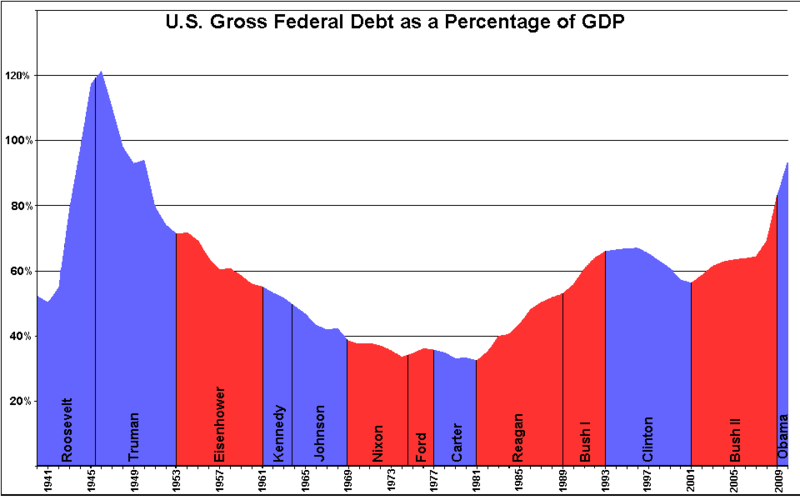
They want the label of ‘deficit hawks’ but they are in fact worse at bringing down the debt than democrats are.

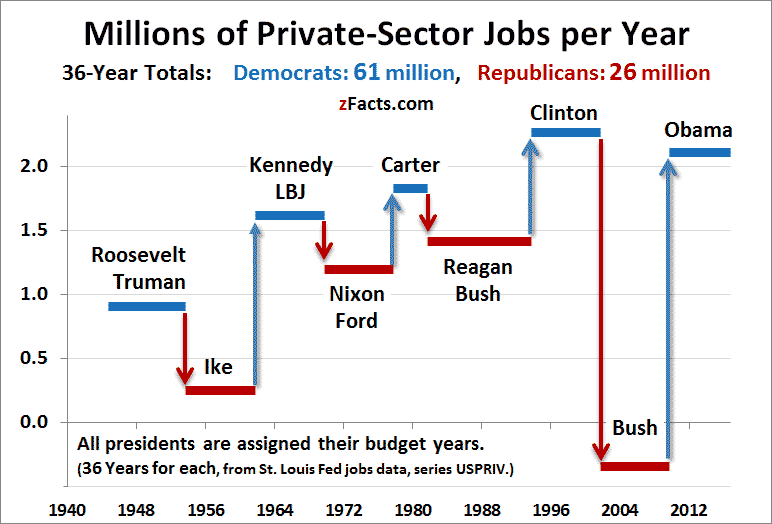
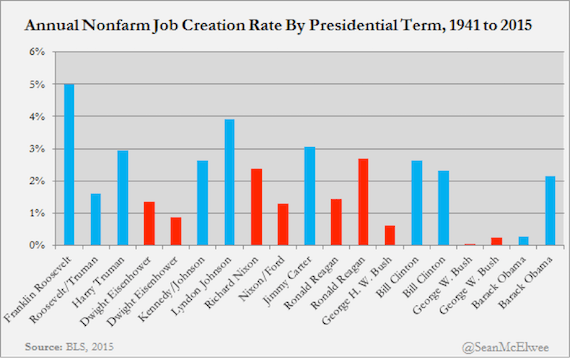
They want the label of ‘job creators’ but in fact job growth has been slower while Republicans have held the Oval Office.

They want us to believe that they are the party of smaller government but in fact they have grown the government more than the democrats have.

It’s a pattern of say one thing, do another.

And the thing that ticks me off the most is that the notion that the economy will somehow grow faster under Republican leadership goes pretty much unchallenged by the media.  Here are a few charts to help debunk this myth.

What other conclusion can you draw from this chart?  Democrats are job creators, Republicans, not so much.

Democrats-create-twice-as-many-Jobs

What’s interesting about this next chart is when you observe the trend starting with the Reagan tax cuts, or the start of ‘trickle down.’  My takeaway is that there’s a significant slope up on the Federal Debt starting with Reagan.  Clinton helped curb it for a little bit, then GW Bush added more tax cuts and the slope continued up. Meanwhile the banks were deregulated and we got hit with The Great Recession which Obama inherited in his first month of office.  The debt increase under Obama was 90% due to the bank failures of 2008 and the subsequent bailout.

The funny thing is, I still recall the outright screaming from some conservative friends on Facebook for Obama to do something as they watched the 401k balances dwindle daily.  They were begging for him to print money.  It was actually entertaining to watch.  And print money they  did.  The banks got bailed out at Tax payer expense.

Democrats went about adding regulations on banks so this couldn’t happen again.  These are the same regulations that Trump just rolled back.  So if the banks get in a world of hurt again, it’s clearly on Trump and the Republicans.

800px-US_Federal_Debt_as_Percent_of_GDP_by_President

This last chart once again debunks the idea that Republicans are job creators.  Reagan had decent numbers but there’s more to the story.  Bush 41 and 43’s numbers stink.

I worked in aerospace for the entire decade of the 1980’s at Boeing up in the Seattle area, so I remember this well.  During Reagan’s first term, there was continued escalation of the arms race with the former Soviet Union.  I saw it every day at work.  Boeing is like most aerospace companies in that it has a commercial side and a military side.  During Reagan’s first term, the commercial side of the business was sucking wind.  Demand for the new fleet of 757’s and 767’s wasn’t matching expectations.  The job economy was terrible.  Interest rates with double digits.  My first home loan was at 12.5%.

The military side of the Boeing however, was picking up the slack for the slumping commercial side.  That probably saved my bacon in retrospect.  At least there was a place to go for a lot of people in Boeing commercial who they needed to cut.

Then something extraordinary happened that would affect the economy in ways that people forget.  The Soviet Union collapsed and that brought about the end of the Cold War.  I give Reagan credit for this.  It was a huge gamble to out-spend the Soviets into submission in the arms race.  But his gamble worked. Ironically the Soviets were dirt poor due to engaging in a fruitless 10 year war with Afghanistan.

For the economy this meant that we as a country, no longer needed to invest billions of dollars into making bombs each year.  At work, the military side of the company started to scale back and suddenly the commercial side picked up.

It’s amazing what happens when you start to invest in products and services that actually have some sellable value.  But the savings to the US economy for not having to compete in the arms race was HUGE.  And it wasn’t just Boeing. Enginneering talent across the country got put to work for better purpose, designing iPods and iPhones instead if ICBMs. Exports increased dramatically. This more than anything explains why jobs started picking up and continued to flourish under Clinton and the dot com boom.

But because of the timing of it, and the fact that Reagan’s infamous trickle down strategy started around the same time, people confuse the ensuing economic prosperity with the tax cuts when in fact they had nothing to do with the tax cuts and everything to do with the end of the Cold War.

presjobs

So here we are 30 years later with Republicans that same trickle down canard. People are not informed enough to understand that contributing to inequality is not how you grow the middle class.  FDR proved that beyond any reasonable doubt.  But every election cycle the Republicans roll that turd out as the answer to all of our prayers.

So yes, taxes are too high.  I AGREE WITH YOU.  Let’s fix the exorbitant amount of waste in government spending by all means.

What should we do about it?  How about learning from our own past history and using what worked?

In my opinion, everything is ripe for review.  Every nickel of spending.  What I am NOT in favor of is blanket cuts which is what Republicans propose.  Blanket cuts are a cop-out because they say “We are spending too much on medicare so we’re going to cut it by 25% and then let the chips fall where they may.”  Well, grandma gets screwed in that scenario and that’s not right.

If you want to cut waste, lets find some waste and cut it.  But don’t propose blanket cuts that screw the poor.  That contributes to inequality.

I’m going to assert that there’s more low hanging fruit in white-collar banking fraud, money laundering and tax cheats (see Trump, Donald J.) than there is in entitlements.  But republicans don’t seem to want to talk about that for some strange reason.  Oh, right.  The donors.

Irrational Exuberance

I hate to spoil the party, but I do think this is worth considering because I’ve been reading cautionary warnings from Paul Krugman and Robert Reich lately.  We haven’t seen this steep of a slope on the S & P 500 since the last 2 times we felt painful crashes in 2000, and 2009.

S_and_P_500_chart_1950_to_2016_with_averages

Having gone through a few of these and felt the pain, it got me to thinking about the new tax legislation just passed by the GOP.  Stock prices are in large part a function of earnings, and expected earnings.  When the markets have crashed in previous years, there have been signals from price/earnings ratios getting too far above the average.  Note that in the chart below, the 10 year average P/E for the S & P is 16.4.  We are currently at 20.5 before the tax cuts have taken full effect.

SP-500-PE-Ratio-history-tactical-investment-management-589x328

Additionally we’re at what is considered peak employment (around 4%) so it’s a fairly tight labor market.  The tax reform plan was sold as a ‘jobs creation’ package.  But who pray-tell, will be filling all these new jobs?  Certainly not immigrants.

What concerns me the most is the well-known practice of CEO’s boosting their own annual compensation by employing stock buy-back programs of their own company’s stock.  This temporarily boosts the prices of the stock, but the problem is, it can’t hold because stock prices are fundamentally based on earnings.

So does this mean that salaries will finally be boosted because of the tight labor market?  Could be.  But I’m being extra cautious about the fantasy that the S&P will continue to rise at this pace.  Historically there’s always been a correction.  All it takes is one world event to trigger it and the next thing you know, your 401k is down 30%.  Boom.

The current run started during the initial stages of the recovery from The Great Recession of 2009.  We’re on a 9 year run.  Obama gets credit for 8 of those years, Trump one year.  We are due for a correction.  In my mind it’s just a question of when.  My vote would be about 6 months before the 2018 mid-terms to ensure justice is served to the architects of this massive giveaway to corporations — who do not need it, and are there’s no incentive tied to getting the tax break.  They just get it whether they create jobs here, ship jobs overseas, or use it to buy back stock.  One of the most idiotic schemes ever legislated.

Hold on to your shirt-tails.

In Praise of Republicans against Raunch

There’s an ancient proverb that says “The enemy of my enemy is my friend.”

I’m reminded of this because I’m both encouraged and fascinated by the list of long time republicans coming out as #NeverTrumpers.  I’m talking about prominent conservatives who have been publicly supportive of the party for decades who are now openly criticizing the president on all forms of media.

As I read the tweets of Rick Wilson, Bill Kristol, Margaret Hoover, Cheri Jacobus, and Ana Navarro for example, I find myself in complete agreement with much of what they are saying.  And these are long time staunch, prominent republicans.   It’s inspiring to see people of stature have enough courage to choose country over party.

So what happened?  My first thought goes back to how brutal the primaries were and how Trump’s nicknames for his opponents ended up sticking.  Little Marco.  Low energy Jeb.  Lyin’ Ted Cruz.  He picked a fight with the establishment from the first debate.  This cost him the support of the entire Bush family and many of its loyal followers including Condoleezza Rice, Colin Powell, Tom Ridge and party pundits Cheri Jacobus, Margaret Hoover, and Steve Schmidt.  Not long ago, these were frequent guests on Fox News supporting candidates McCain and Romney.

Next was the infamous kerfuffle with Megyn Kelly during the first debate.  The fallout from the was a loss of support from strong women like Ana Navarro and Jennifer Rubin.

It’s much easier to come out as a #NeverTrumper when you are personally attacked.

When George W. Bush was president, I wrote plenty on policy differences and the inherent greed of the republican party, but I never once suspected him of being a racist.  In fact, just the opposite.  He always went out of his way to be inclusive of all Americans. He understood basic decency in addition to the political necessity of having moderate Muslims on your side to win the war on terror.  In this regard, he was a good man.

Charlottesville was where I think Trump lost the last vestige of hope he had from the republican establishment.  His “both sides” narrative caused several other prominent republican figures to join the #NeverTrump bandwagon.

In the Netflix series “The Crown”, prince Phillip sent Charles to the same boys school he attended as a child – and hated.  Predictably, Charles hated it too.  It was a clear example of the “strict father” approach.  The “my dad made me do things I didn’t like, but it made a man out of me” mindset.

It used to be that you could count on the representatives of the party to be supporting a platform straight from the strict father paradigm, complete with personal responsibility, hard work, love of God and country.  There’s nothing inherently wrong with this message.  The issue has always been where to set the social safety net.  Democrats have pushed more towards socialism.  Republicans would like a society where, if you make bad choices, that’s your tough shit.  They don’t understand the concept of having been born on third base, and the message about compassion got lost somewhere between the sermon and coffee and donuts.

But recently the party tent has gotten a little too wide for many.  It’s as if long time republicans got invited to an upscale Ivy League frat party, got all dressed up and expected an evening of social snobbery and cigars, but then the host let the Nazi’s from down the street in, and started excluding people at the door for their religion and race.  And then, late in the evening the jokes about pussy grabbing started.  At that point, some started to realize they were living the Animal House experience, felt uncomfortable with the level of raunchy behavior now inside the party tent and decided to check out.

During the 1980 presidential campaign Ronald Reagan was asked why he left the Democratic party.  “I didn’t leave the party”, he said.  “The party left me.”  I’m pretty sure this is example what is happening with the current GOP.

Twitter gave Trump a direct line to the American people and it was an effective tool for him to get his message across, however deceitful.  But there’s also a saying about what goes around comes around.  The same tool that can prop a guy up to the highest office in the land can also take him down.  If you have the chance, I’d encourage you to follow these courageous republicans on Twitter.  I’m liking what I am hearing because it gives me hope we can get back to some sense of normalcy.

===== Twitter Handles of Prominent #NeverTrump Republicans =====

@BillKristol, @CheriJacobus, @TheRickWilson, @SteveSchmidtSES, @ananavarro, @GeorgeWill, @nytdavidbrooks, @douthatNYT, @MJGerson, @MargaretHoover, @JRubinBlogger, @benshapiro, @CondoleezzaRice,


2017 – The Year in Review

We’re not very good at sending out Christmas cards anymore, so WordPress it is.

Speaking of review, I recently revisited a blog post I had written a year ago Adios 2016 which was less than upbeat.  In memory of a dear friend who passed away this year, here’s how it started out:

Back in the mid 1980’s, an activist friend of mind Dave Aldrich sent out a memorable Christmas letter that was definitely one of a kind.  In this short missive he astutely pointed out about a dozen things that are just wrong in this world, covering the gamut from wasteful military spending, the oxymoron of compassionate conservatism, greedy politicians, abject poverty, the decline of unions and the middle class, and tax cuts for the wealthy.  It was a pithy list of gripes and then he simply signed it –“Merry Christmas.”

I always admired this independent minded thinker, and the courage to send that out.  I’ve been tempted a few times myself.

I’m happy to report I’m much more upbeat going into 2018!  This may be hard to fathom since 90% of my posts are negative, but having given republicans a full year to implode (and them not disappointing me by exceeding my implosion expectations), I can say with certainty that this year’s review will include quite a few more affirmative statements.

January and February will henceforth be remembered as “the back surgery months.”  You don’t want to hear the specifics about my back woes.  Suffice it to say, a lot of pills, a couple of relatively minor surgeries and I’m back in business.

Our financial plan doesn’t permit us to take a big trip every year.  2017 was destined to be the year of “a lot of small, but enjoyable trips” and definitely lived up to that.

In April we spent a four-day weekend with our friends Wayne and Tricia at their new home in Sahuarita, Arizona, just south of Tucson.  It was really great to see them again and tool around, experiencing the southern part of the U.S., which we don’t get to do very often.  Nothing fancy, just good friends and good times.

Early summer we spent a long weekend out at Crystal Mountain Sports Haus in Vernonia with a group of friends and enjoyed a lot of laughs.  Some were bikers.  Others golfers.  Such a great getaway that’s sort of right in our back yard.

Late summer we lost Donna’s step-dad Harvey.  He was a definitely a character and will be sorely missed at this year’s gatherings.  Being involved with Donna’s mom’s move to a retirement home kept Donna busy through the summer.  The good news is that Janet has settled in nicely in her new place and is doing really well.

August was definitely jam packed as we traveled up to the Seattle area for the annual family reunion at Lake Margaret hosted by my sister Jackie and brother-in-law Rich Watkins.  The lake was warm.  The card games were very memorable.  We had a fun time as usual.

No sooner did we get back from Lake Margaret and I’ll be darned if Donna didn’t have an outdoor backyard birthday party here at the house where I was joined by former band-mate David Poarch in a live duo performance that was a terrific experience.  The best memory from that evening was dedicating a song “To Love Somebody” by the Bee Gees to my son Dan and his fiancé Emily.

The next weekend we traveled down to the Junction City area to participate in Dan and Emily’s wedding, complete with over 100 seats from Autzen stadium circa 1967.  The weather cooperated, the dance floor was full, the couple looked extremely happy, and dad was proud.  What more can I say?

I’ll be darned if we didn’t have another family wedding to go to in October when my nephew Jeff Stein got married in Santa Barbara, CA.  We made a 3 day weekend out of it and had a wonderful time with…. all the people we just saw at Lake Margaret and Dan and Emily’s wedding.  Oh well, it was good to see them again!

In early December Donna and I rented a place at Black Butte ranch for the weekend and took Pickles with us.  She only escaped once.  Luckily we found her before it got dark.  We didn’t do a whole lot on that trip other than venture into Sisters and visit the Head of the Metolius River, but that was the point.  So mission accomplished.

We’ve also very fortunate to have a circle of friends who like to get together about once a month and have themed dinner of sorts.  Food from around the globe or get in the spirit of an event like the Kentucky Derby – and dress the part.  Donna and I actually bet money online and came out ahead.  Beginner’s luck I guess.  When it’s at our place, they indulge my guitar playing for a few songs.  It’s almost like I have a gig.  There’s no tip jar but they threw money my way anyway, so I must have done something right.

Other than work (ugh), we have our little side projects we do.  Donna is constantly exploring new art forms.  I won’t pretend I know anything about art so you can talk to her about it, but the creations are definitely unique and her brain child.  I’ve gotten back into music a little bit when I’m not working (ugh).  A friend of mine gifted me his old electronic drum kit so I have that to dink around with.  I recently started up lessons again.  I’m starting to put tunes out on soundcloud.com as time allows with myself on guitars, bass, keys, and drums.  Maybe if I get a few decent ones out there I’ll send the link around.  Right now I’m definitely a work in progress.

To end on an upbeat note, Donna and I have completely ditched CNN and are faithful followers of Rachel Maddow now.  That’s our new show.  And she rocks.  Donna is now a daily Twitter user.  She doesn’t post a lot, but we have fun sharing the Tweets we’ve read.

With any luck, the FBI will be heading to the supply locker to fetch around 20 pairs of handcuffs one of these days making for an awesome 2018!