The Myth of the Republican Economy

I had a back and forth exchange with my realtor about 10 years ago about taxes.  He was trying to make the point that democrats don’t work hard enough at limiting spending.  That taxes were/are out of control.  Jeff was an educated guy, super sharp and personable so the exchange was pleasant.  It was one of those rare debates where I’m engaging with a conservative and he literally had an answer / good comeback for every single point I made.

He’s right.  Taxes are too high.  As a general rule, our government officials waste an awful lot of money.  Jeff brought forth example after example and it became hard to counter. In the end, after thinking about it I came to agree with a lot of what he was saying.

But it didn’t turn me into a Republican or a conservative and here’s why:

The Republicans are full of shit when it comes to their economic strategy.  

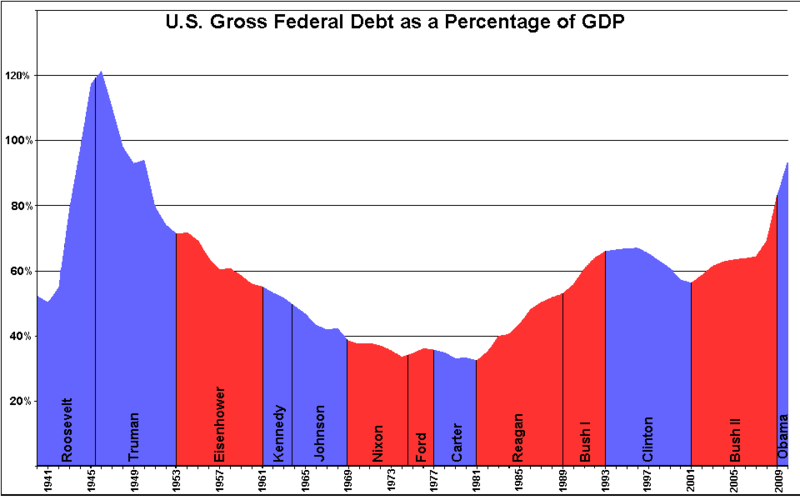
They want the label of ‘deficit hawks’ but they are in fact worse at bringing down the debt than democrats are.

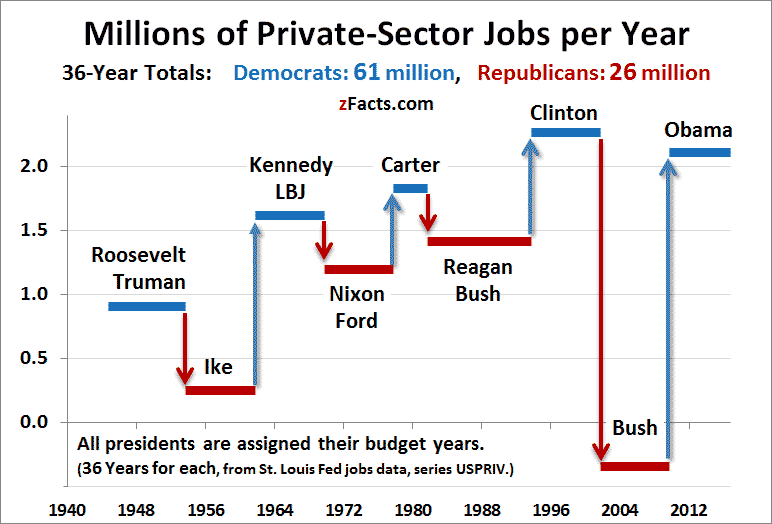
They want the label of ‘job creators’ but in fact job growth has been slower while Republicans have held the Oval Office.

They want us to believe that they are the party of smaller government but in fact they have grown the government more than the democrats have.

It’s a pattern of say one thing, do another.

And the thing that ticks me off the most is that the notion that the economy will somehow grow faster under Republican leadership goes pretty much unchallenged by the media.  Here are a few charts to help debunk this myth.

What other conclusion can you draw from this chart?  Democrats are job creators, Republicans, not so much.

Democrats-create-twice-as-many-Jobs

What’s interesting about this next chart is when you observe the trend starting with the Reagan tax cuts, or the start of ‘trickle down.’  My takeaway is that there’s a significant slope up on the Federal Debt starting with Reagan.  Clinton helped curb it for a little bit, then GW Bush added more tax cuts and the slope continued up. Meanwhile the banks were deregulated and we got hit with The Great Recession which Obama inherited in his first month of office.  The debt increase under Obama was 90% due to the bank failures of 2008 and the subsequent bailout.

The funny thing is, I still recall the outright screaming from some conservative friends on Facebook for Obama to do something as they watched the 401k balances dwindle daily.  They were begging for him to print money.  It was actually entertaining to watch.  And print money they  did.  The banks got bailed out at Tax payer expense.

Democrats went about adding regulations on banks so this couldn’t happen again.  These are the same regulations that Trump just rolled back.  So if the banks get in a world of hurt again, it’s clearly on Trump and the Republicans.

800px-US_Federal_Debt_as_Percent_of_GDP_by_President

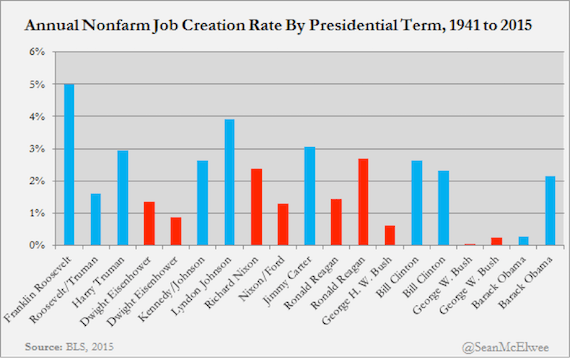
This last chart once again debunks the idea that Republicans are job creators.  Reagan had decent numbers but there’s more to the story.  Bush 41 and 43’s numbers stink.

I worked in aerospace for the entire decade of the 1980’s at Boeing up in the Seattle area, so I remember this well.  During Reagan’s first term, there was continued escalation of the arms race with the former Soviet Union.  I saw it every day at work.  Boeing is like most aerospace companies in that it has a commercial side and a military side.  During Reagan’s first term, the commercial side of the business was sucking wind.  Demand for the new fleet of 757’s and 767’s wasn’t matching expectations.  The job economy was terrible.  Interest rates with double digits.  My first home loan was at 12.5%.

The military side of the Boeing however, was picking up the slack for the slumping commercial side.  That probably saved my bacon in retrospect.  At least there was a place to go for a lot of people in Boeing commercial who they needed to cut.

Then something extraordinary happened that would affect the economy in ways that people forget.  The Soviet Union collapsed and that brought about the end of the Cold War.  I give Reagan credit for this.  It was a huge gamble to out-spend the Soviets into submission in the arms race.  But his gamble worked. Ironically the Soviets were dirt poor due to engaging in a fruitless 10 year war with Afghanistan.

For the economy this meant that we as a country, no longer needed to invest billions of dollars into making bombs each year.  At work, the military side of the company started to scale back and suddenly the commercial side picked up.

It’s amazing what happens when you start to invest in products and services that actually have some sellable value.  But the savings to the US economy for not having to compete in the arms race was HUGE.  And it wasn’t just Boeing. Enginneering talent across the country got put to work for better purpose, designing iPods and iPhones instead if ICBMs. Exports increased dramatically. This more than anything explains why jobs started picking up and continued to flourish under Clinton and the dot com boom.

But because of the timing of it, and the fact that Reagan’s infamous trickle down strategy started around the same time, people confuse the ensuing economic prosperity with the tax cuts when in fact they had nothing to do with the tax cuts and everything to do with the end of the Cold War.

presjobs

So here we are 30 years later with Republicans that same trickle down canard. People are not informed enough to understand that contributing to inequality is not how you grow the middle class.  FDR proved that beyond any reasonable doubt.  But every election cycle the Republicans roll that turd out as the answer to all of our prayers.

So yes, taxes are too high.  I AGREE WITH YOU.  Let’s fix the exorbitant amount of waste in government spending by all means.

What should we do about it?  How about learning from our own past history and using what worked?

In my opinion, everything is ripe for review.  Every nickel of spending.  What I am NOT in favor of is blanket cuts which is what Republicans propose.  Blanket cuts are a cop-out because they say “We are spending too much on medicare so we’re going to cut it by 25% and then let the chips fall where they may.”  Well, grandma gets screwed in that scenario and that’s not right.

If you want to cut waste, lets find some waste and cut it.  But don’t propose blanket cuts that screw the poor.  That contributes to inequality.

I’m going to assert that there’s more low hanging fruit in white-collar banking fraud, money laundering and tax cheats (see Trump, Donald J.) than there is in entitlements.  But republicans don’t seem to want to talk about that for some strange reason.  Oh, right.  The donors.

Irrational Exuberance

I hate to spoil the party, but I do think this is worth considering because I’ve been reading cautionary warnings from Paul Krugman and Robert Reich lately.  We haven’t seen this steep of a slope on the S & P 500 since the last 2 times we felt painful crashes in 2000, and 2009.

S_and_P_500_chart_1950_to_2016_with_averages

Having gone through a few of these and felt the pain, it got me to thinking about the new tax legislation just passed by the GOP.  Stock prices are in large part a function of earnings, and expected earnings.  When the markets have crashed in previous years, there have been signals from price/earnings ratios getting too far above the average.  Note that in the chart below, the 10 year average P/E for the S & P is 16.4.  We are currently at 20.5 before the tax cuts have taken full effect.

SP-500-PE-Ratio-history-tactical-investment-management-589x328

Additionally we’re at what is considered peak employment (around 4%) so it’s a fairly tight labor market.  The tax reform plan was sold as a ‘jobs creation’ package.  But who pray-tell, will be filling all these new jobs?  Certainly not immigrants.

What concerns me the most is the well-known practice of CEO’s boosting their own annual compensation by employing stock buy-back programs of their own company’s stock.  This temporarily boosts the prices of the stock, but the problem is, it can’t hold because stock prices are fundamentally based on earnings.

So does this mean that salaries will finally be boosted because of the tight labor market?  Could be.  But I’m being extra cautious about the fantasy that the S&P will continue to rise at this pace.  Historically there’s always been a correction.  All it takes is one world event to trigger it and the next thing you know, your 401k is down 30%.  Boom.

The current run started during the initial stages of the recovery from The Great Recession of 2009.  We’re on a 9 year run.  Obama gets credit for 8 of those years, Trump one year.  We are due for a correction.  In my mind it’s just a question of when.  My vote would be about 6 months before the 2018 mid-terms to ensure justice is served to the architects of this massive giveaway to corporations — who do not need it, and are there’s no incentive tied to getting the tax break.  They just get it whether they create jobs here, ship jobs overseas, or use it to buy back stock.  One of the most idiotic schemes ever legislated.

Hold on to your shirt-tails.

In Praise of Republicans against Raunch

There’s an ancient proverb that says “The enemy of my enemy is my friend.”

I’m reminded of this because I’m both encouraged and fascinated by the list of long time republicans coming out as #NeverTrumpers.  I’m talking about prominent conservatives who have been publicly supportive of the party for decades who are now openly criticizing the president on all forms of media.

As I read the tweets of Rick Wilson, Bill Kristol, Margaret Hoover, Cheri Jacobus, and Ana Navarro for example, I find myself in complete agreement with much of what they are saying.  And these are long time staunch, prominent republicans.   It’s inspiring to see people of stature have enough courage to choose country over party.

So what happened?  My first thought goes back to how brutal the primaries were and how Trump’s nicknames for his opponents ended up sticking.  Little Marco.  Low energy Jeb.  Lyin’ Ted Cruz.  He picked a fight with the establishment from the first debate.  This cost him the support of the entire Bush family and many of its loyal followers including Condoleezza Rice, Colin Powell, Tom Ridge and party pundits Cheri Jacobus, Margaret Hoover, and Steve Schmidt.  Not long ago, these were frequent guests on Fox News supporting candidates McCain and Romney.

Next was the infamous kerfuffle with Megyn Kelly during the first debate.  The fallout from the was a loss of support from strong women like Ana Navarro and Jennifer Rubin.

It’s much easier to come out as a #NeverTrumper when you are personally attacked.

When George W. Bush was president, I wrote plenty on policy differences and the inherent greed of the republican party, but I never once suspected him of being a racist.  In fact, just the opposite.  He always went out of his way to be inclusive of all Americans. He understood basic decency in addition to the political necessity of having moderate Muslims on your side to win the war on terror.  In this regard, he was a good man.

Charlottesville was where I think Trump lost the last vestige of hope he had from the republican establishment.  His “both sides” narrative caused several other prominent republican figures to join the #NeverTrump bandwagon.

In the Netflix series “The Crown”, prince Phillip sent Charles to the same boys school he attended as a child – and hated.  Predictably, Charles hated it too.  It was a clear example of the “strict father” approach.  The “my dad made me do things I didn’t like, but it made a man out of me” mindset.

It used to be that you could count on the representatives of the party to be supporting a platform straight from the strict father paradigm, complete with personal responsibility, hard work, love of God and country.  There’s nothing inherently wrong with this message.  The issue has always been where to set the social safety net.  Democrats have pushed more towards socialism.  Republicans would like a society where, if you make bad choices, that’s your tough shit.  They don’t understand the concept of having been born on third base, and the message about compassion got lost somewhere between the sermon and coffee and donuts.

But recently the party tent has gotten a little too wide for many.  It’s as if long time republicans got invited to an upscale Ivy League frat party, got all dressed up and expected an evening of social snobbery and cigars, but then the host let the Nazi’s from down the street in, and started excluding people at the door for their religion and race.  And then, late in the evening the jokes about pussy grabbing started.  At that point, some started to realize they were living the Animal House experience, felt uncomfortable with the level of raunchy behavior now inside the party tent and decided to check out.

During the 1980 presidential campaign Ronald Reagan was asked why he left the Democratic party.  “I didn’t leave the party”, he said.  “The party left me.”  I’m pretty sure this is example what is happening with the current GOP.

Twitter gave Trump a direct line to the American people and it was an effective tool for him to get his message across, however deceitful.  But there’s also a saying about what goes around comes around.  The same tool that can prop a guy up to the highest office in the land can also take him down.  If you have the chance, I’d encourage you to follow these courageous republicans on Twitter.  I’m liking what I am hearing because it gives me hope we can get back to some sense of normalcy.

===== Twitter Handles of Prominent #NeverTrump Republicans =====

@BillKristol, @CheriJacobus, @TheRickWilson, @SteveSchmidtSES, @ananavarro, @GeorgeWill, @nytdavidbrooks, @douthatNYT, @MJGerson, @MargaretHoover, @JRubinBlogger, @benshapiro, @CondoleezzaRice,


2017 – The Year in Review

We’re not very good at sending out Christmas cards anymore, so WordPress it is.

Speaking of review, I recently revisited a blog post I had written a year ago Adios 2016 which was less than upbeat.  In memory of a dear friend who passed away this year, here’s how it started out:

Back in the mid 1980’s, an activist friend of mind Dave Aldrich sent out a memorable Christmas letter that was definitely one of a kind.  In this short missive he astutely pointed out about a dozen things that are just wrong in this world, covering the gamut from wasteful military spending, the oxymoron of compassionate conservatism, greedy politicians, abject poverty, the decline of unions and the middle class, and tax cuts for the wealthy.  It was a pithy list of gripes and then he simply signed it –“Merry Christmas.”

I always admired this independent minded thinker, and the courage to send that out.  I’ve been tempted a few times myself.

I’m happy to report I’m much more upbeat going into 2018!  This may be hard to fathom since 90% of my posts are negative, but having given republicans a full year to implode (and them not disappointing me by exceeding my implosion expectations), I can say with certainty that this year’s review will include quite a few more affirmative statements.

January and February will henceforth be remembered as “the back surgery months.”  You don’t want to hear the specifics about my back woes.  Suffice it to say, a lot of pills, a couple of relatively minor surgeries and I’m back in business.

Our financial plan doesn’t permit us to take a big trip every year.  2017 was destined to be the year of “a lot of small, but enjoyable trips” and definitely lived up to that.

In April we spent a four-day weekend with our friends Wayne and Tricia at their new home in Sahuarita, Arizona, just south of Tucson.  It was really great to see them again and tool around, experiencing the southern part of the U.S., which we don’t get to do very often.  Nothing fancy, just good friends and good times.

Early summer we spent a long weekend out at Crystal Mountain Sports Haus in Vernonia with a group of friends and enjoyed a lot of laughs.  Some were bikers.  Others golfers.  Such a great getaway that’s sort of right in our back yard.

Late summer we lost Donna’s step-dad Harvey.  He was a definitely a character and will be sorely missed at this year’s gatherings.  Being involved with Donna’s mom’s move to a retirement home kept Donna busy through the summer.  The good news is that Janet has settled in nicely in her new place and is doing really well.

August was definitely jam packed as we traveled up to the Seattle area for the annual family reunion at Lake Margaret hosted by my sister Jackie and brother-in-law Rich Watkins.  The lake was warm.  The card games were very memorable.  We had a fun time as usual.

No sooner did we get back from Lake Margaret and I’ll be darned if Donna didn’t have an outdoor backyard birthday party here at the house where I was joined by former band-mate David Poarch in a live duo performance that was a terrific experience.  The best memory from that evening was dedicating a song “To Love Somebody” by the Bee Gees to my son Dan and his fiancé Emily.

The next weekend we traveled down to the Junction City area to participate in Dan and Emily’s wedding, complete with over 100 seats from Autzen stadium circa 1967.  The weather cooperated, the dance floor was full, the couple looked extremely happy, and dad was proud.  What more can I say?

I’ll be darned if we didn’t have another family wedding to go to in October when my nephew Jeff Stein got married in Santa Barbara, CA.  We made a 3 day weekend out of it and had a wonderful time with…. all the people we just saw at Lake Margaret and Dan and Emily’s wedding.  Oh well, it was good to see them again!

In early December Donna and I rented a place at Black Butte ranch for the weekend and took Pickles with us.  She only escaped once.  Luckily we found her before it got dark.  We didn’t do a whole lot on that trip other than venture into Sisters and visit the Head of the Metolius River, but that was the point.  So mission accomplished.

We’ve also very fortunate to have a circle of friends who like to get together about once a month and have themed dinner of sorts.  Food from around the globe or get in the spirit of an event like the Kentucky Derby – and dress the part.  Donna and I actually bet money online and came out ahead.  Beginner’s luck I guess.  When it’s at our place, they indulge my guitar playing for a few songs.  It’s almost like I have a gig.  There’s no tip jar but they threw money my way anyway, so I must have done something right.

Other than work (ugh), we have our little side projects we do.  Donna is constantly exploring new art forms.  I won’t pretend I know anything about art so you can talk to her about it, but the creations are definitely unique and her brain child.  I’ve gotten back into music a little bit when I’m not working (ugh).  A friend of mine gifted me his old electronic drum kit so I have that to dink around with.  I recently started up lessons again.  I’m starting to put tunes out on soundcloud.com as time allows with myself on guitars, bass, keys, and drums.  Maybe if I get a few decent ones out there I’ll send the link around.  Right now I’m definitely a work in progress.

To end on an upbeat note, Donna and I have completely ditched CNN and are faithful followers of Rachel Maddow now.  That’s our new show.  And she rocks.  Donna is now a daily Twitter user.  She doesn’t post a lot, but we have fun sharing the Tweets we’ve read.

With any luck, the FBI will be heading to the supply locker to fetch around 20 pairs of handcuffs one of these days making for an awesome 2018!

Taking one for the Team

I’ve always admired Al Franken and today was no exception.  His speech on the Senate floor today was one I’ll remember for a long time.  He owned up to making women feel uncomfortable and with the timing of the #MeToo movement, there just isn’t any room for debate about his intent versus how it was received.

Note that we’re not talking about adultery here, or anything close really.  As a former comedian he probably crossed some lines he shouldn’t have and now regrets it.  But the point is, he’s owning up to it and now realizes this is not the time for an investigation.  In fact, it’s an opportunity.  Because while the Democrats are in the midst of cleaning house — calling for the ouster of Conyers and Franken, the Republicans are writing checks in support of an accused child molester and somehow have no issue with working hand in glove with the pussy-grabber in chief.  It’s important to notice the omission of the word “alleged” along with the words pussy-grabber in chief.  There’s a tape of it. 

This gives Democrats the moral high ground on this issue and I think that’s important.  Minnesota will elect another Senator and be fine.  By taking one for the team, Franken took the whole what-about-ism debate off the table.  The only question on the table now is how Republicans deal with their own house, and we’ve already seen the strategy.  When accused, double down – it’ll be perceived as a show of strength.

Not this time however.  I’m anxious to see the numbers when November 2018 rolls around, but Republicans are going to do terrible with women, Gen Xers, and Millennials.  And it will be well deserved.

Attribution

The stuffed white shirts have nothing to do with the movement. Per @MJGerson:

“The strong, moral commitment to the dignity of women and children recently asserting itself in our common life has mainly come from feminism, not the ‘family values’ movement. In this case, religious conservatives have largely been bystanders or obstacles.”

See: Falwell, Jerry Jr.

Thanksgiving and Thanks

As one of the top complainers on the internet, I figured it’d be a good change of pace today to come up with some things I am thankful for.  I have every expectation this will be an easy exercise.

First, I am thankful I was lucky enough to be raised by Jim and Gwen Toner.  It all kind of starts there, right?  Our parents are our main influences, and without them, we wouldn’t be the people we are today.  I could list 100 things about them both that I am thankful for, but I’ll just mention the one that has stayed with me the longest over time.  They both understood that raising children involved making personal sacrifices.  Because of their understanding of this, I know I’m in a better place than many.  We didn’t have a lot of money.  We never owned a boat or fancy cars.  I don’t recall a vacation that wasn’t either camping or climbing into the car for a long drive.  If anything, the family had quite a bit of medical related debt most of the time, but we had each other and a vision about the type of person they were trying to mold us into — work ethic, attitude and moral compass were always high on the list — with room to be yourself as well.   Mom’s example taught me that all you really need in life is a good group of friends and deck of cards.  Dad taught me that the harder I try, the luckier I get.   The educational experience I was exposed to taught me that wealth is a relative thing.  Even with an uphill battle ahead of us to get ahead, compared to 2/3 of the rest of the world, The Toner family — all 6 of us living on a middle school teacher’s income most of the time, were born on 3rd base.   I’m reminded of that often.

I am also thankful for my loving wife Donna who gets me at the deepest level and accepts me for who I am at all times.  We are very different individuals.  In many cases polar opposites.  Yet I am so enriched by her presence and lucky to have found her that I try to never take that for granted.   I wish everyone could be this lucky.   The last 9 years have been an amazing journey.  In our vows we both acknowledged that life will bring us headwinds, and to be sure it has.  But at the core, if you’re with someone who has the head and the heart to deal with adversity, you have nothing to worry about.  That’s why when I proposed, and said those vows, I didn’t think twice about it and have been living a charmed life ever since.  Grow old with your best friend is a beautiful thing.

Since last Thanksgiving I have two new daughter-in-laws that I’m very thankful for.  Ari and Emily are enriching Rob and Dan in much the same way Donna enriches me.  This was a New Year’s wish of mine a few years ago … that my son’s meet a nice girl, and it came to be.  I am thankful for the boys finding their soul mates and carving out paths for themselves and being independent men who think for themselves always.

I am thankful the Gilpin family who has makes me proud every day in the way they raise our 2 grandchildren, Kaden and Karter.  These are going to be two fine young men.  I’ll bet the farm on it.

I am grateful for my sisters who are all wonderful human beings in every way.  The competition continues this day with Words with Friends and after going 0-fer the 1960’s against them in every game imaginable, I’m finally getting some satisfaction out of game playing with them.  I’m not sure if they let me win once in a while or not, but it sure feels good when I do.  Thank goodness for the word “strength meter” or else I’d lose every time.   That tool levels the playing field a bit.

I am thankful for my extended Fritts family who, despite my wearing Duck gear, invite me to join at their Thanksgiving feast every year.  This year had some challenges and adversity in having to deal with a death in the family and moving mom.   It was awesome to witness the incredible teamwork in the face of all of this.  I’m sure that the 5 kids are just as thankful for Janet and Dorence as I am of Jim and Gwen for much the same reasons.  When the chips are down, the family hangs together.

I’m very thankful for my friends.  In recent years I’ve come to the conclusion that it’s good to go for quality over quantity.  Well, duh, that should have been obvious, but some of us are slow learners.   It’s not easy being my friend sometimes, especially if you’re a Republican.  So thanks for hanging in there Karla and Mike!   Mom’s example of the deck of cards and good group of friends often crosses my mind these days.

I am thankful for my health.  It’s not been stellar of late – some minor bumps in the road, but once again I’m reminded of the relative nature of this.  Compared to the rest of the world, my health is on 3rd base.   As we encounter friends and family who also battle health issues, it’s a constant reminder to live in the moment.  Ever the planner, that’s a concept that has taken a while to register with me, but I’m getting there.

I’m thankful that through nothing more than chance, I was born in one of the most awesome areas in the world, the Pacific Northwest, which, after visiting other parts of the country, man it’s nice to step back onto that one of a kind carpet at PDX and get to call this place home.

Last but not least, I’m thankful that I live in a country where we have the first amendment (which I freely exercise on Twitter daily).  The struggles of the past year that are tearing at the very fabric of this country and sure to be temporary.   Sometimes the pendulum swings pretty far in one direction but it always corrects itself.  I’m confident in that we’ll be okay.  We might have to go through some pain in the short-term, but we’ll get through it.  I believe the goodness of the human spirit will prevail in the long run.  My approach has been to be a part of the resistance movement, which feels right to me.  I’m thankful everyone who joins in the resistance movement in whatever way they are able to.


The Political Jesus

I mentioned in a previous post that I had signed up for a 2 day seminar on The Political Jesus, which was held November 10th and 11th.  An article in The Times piqued my interest and after checking it out a little bit, I figured it might be an interesting endeavor.

Motivation

Since on a good day, this blog has about 3 followers, and I’d guess over half my Facebook friends are pretty sick of my political posts and have me on ignore, one might wonder why I bother.  Well, sometimes I do too.  But I think the answer is, it’s really for me, not you.  I do this for myself because it’s a part of who I am.  Given my knowledge in this area (hint: about as dumb as it gets) I do not seek to preach about anything.  Far from it.  I simply find it interesting.  I have an innate curiosity.  If you do as well, feel free to read on.  If not, by all means go do something else.

There’s a fair amount of evidence in this blog and on Facebook that suggest I may have an ax to grind with Republicans.  Okay, I’ll own that one.  The same is not true of Christians however.  I have no ax to grind with anyone’s faith practice.  We may differ on what works for us as that’s a very personal, individual, and experiential thing.   But I like to think I’m open-minded enough to not scoff at the way in which people practice a faith.  As far as I’m concerned, knock yourself out.  There might be one exception to this.  I’ll admit to frustration with those who are quick to espouse strong opinions combined with being not very well-informed.  I’ve run into a few people like that, but the majority of people I know and love are intelligent people doing what feels right for them, and I couldn’t be happier about that.

It’s necessary to point this out as this particular seminar combines the two things you’re not supposed to bring up at a dinner party: politics and religion.

Influences

I think everyone runs into a few people in their life who are highly influential.  Impact players is how I think of them.  Sometimes I make a list of the top 5 people who have influenced my life in one way or another.  It’s an interesting exercise.  The same can be true of authors/books.  Sometimes you read something that gives you that aha moment that lasts.  Two of mine are David Aldrich – author of www.snohomishobserver.com, and Karen Armstrong – author of “A History of God

It was hard not to be in awe of just how brilliant Dave was.  We used to have a weekly breakfast with a group of guys for the sole purpose of discussing the things you’re not supposed to talk about in a social settings: religion and politics.  Absolutely fascinating.

Dave was a modern-day social justice warrior in every sense of the word.  He led protests, blogged in favor of the little guy, and questioned authority at every turn.  He paid a pretty steep price at times for living by his ideals.  He had been at times, very successful in business, but more often than not, his insistence in standing by his principles cost him in the private sector.   At a young age he was ousted from Pemco for attempting to organize a union.  He believed it was the right thing to do and did until his dying day.  But he didn’t care about being rich.  He cared about doing the right thing.  He was a rare breed.

A History of God gave me an appreciation of highly educated people who have done deep dives on the subject of religion in attempts to tie it all together.  Judaism, Christianity, and Islam have a common denominator – each faith traces its roots back to Abraham.

Admittedly, much of what Armstrong writes is over my head.  I concluded her target audience must be mostly other well-educated historians.  But I definitely had some useful takeaways.

As an example, when everything is put into the context of a timeline, it’s interesting to find out that as a people, we humans transitioned back and forth a few times between the notion of God in the plural form to monotheism up until about 680 CE.  I grew up thinking that pretty much monotheism was settled matter except for maybe during the time of cavemen.

Additionally Armstrong challenges us to go through the exercise of reconciling our religious and political beliefs.  Trust me, this is not an easy exercise, but it’s a worthy one.

Speaking of timelines, one other thing I hadn’t considered until reading Armstrong – the books of the bible were written by a collection of authors between 800 BC and 110 CE.  That’s 910 years.  So there are numerous books that make up what people refer to as “the infallible word of God” written by dozens of authors with vastly different perspectives and agendas.  I’ve always felt that explains a lot.  I’m 57 years old and the world is a lot different now that it was in 1960.  910 years is an incredibly long time.   It then becomes incumbent upon me to put this little factoid into perspective as I move ahead with everything else I learn.

The Presenters

Reading the bios of the presenters intrigued me as I had already discovered that as a self-professed dumb person, it’s interesting to hang out with intelligent people when you can.

The detailed bios of Arthur J. Dewey and Celine Little can be seen here.

Just having a Ph.D. doesn’t make you always right.  I get that.  One has to be careful about the sources of information we choose to learn from.  It’s a good idea to try to sniff out any underlying motivation someone might have for the particular message they are sending.  Is it financial?  Is it to try to recruit?  Is it to espouse conspiracy theories and gain followers?  Why are you here anyway?

I was pretty happy with the end result in that the whole time I felt like both presenters were in the education business.  Both had written books and yes, they were for sale but less than $20.

Admittedly there were times when I was a little lost just because I’m not familiar enough with the players in history to keep up with the story.  But you gotta start somewhere.

Context is Important

We spent Friday night learning about the social and economic context of the early followers of Jesus from the first century.   Enter: The Roman Empire.

A full discussion on the Roman Empire in the early centuries CE is both out of scope for a blog post and also, beyond my ability to articulate anything insightful because I honestly don’t know anything insightful.  It’s not been a strong area of study for me at any point in my academic career.  But I can share a few takeaways.  Here’s what I learned:

  • The Roman Empire was a brutal regime
    • If you’ve seen Gladiator or The Borgias, which would have been several centuries later, you would have an understanding of how brutal the Emperors were in constructing the Roman Empire.
  • The Jewish-Roman War of 66 – 70 CE was particularly brutal
    • Over 1M people killed.  100,000 enslaved.
    • To the victors belong the spoils.
      • The Roman Colosseum was one artifact built with the spoils 70 – 80 CE
    • Public humiliation was a big part of it, even after the war was over
      • Coins that depicted Romans as the masters and Jews as the slaves
  • These facts are important for centuries later to give context to the intense anger between the Romans and the Jews

Dyadics and the Social Pyramid

In the graphic below, the top-tier of Senators and Administrators represents 5% of the population.  The Nobles, Patricians and wealthy Plebeians represent 10%.  The remaining 85% of the population are what Dewey referred to as the Dyadic’s – lesser human beings in more of a servitude role.  A simpler way to think of it is, the top 15% considered themselves worthy of the gifts they received.  The bottom 85% were there to serve the top 15% – or else.

ancient-rome-hierarchy-3-638

Additionally the Dyadic’s in general had the following characteristics

  • My identity is found in others’ eyes
  • My social group defines me
  • Change requires going beyond my means
  • If one does attempt to change out of this group, they are labeled
  • To venture out of the Dyadic group with your thought process is rebellion

Lastly, for the pyramid scheme to hold, the bottom 85% needed to believe they belonged there.  The upper echelon addressed this issue though (in large part), fear.

There are artifacts that when closely studied by historians depict the notion that the culture of the Roman Empire was such that the closer you were to the top of the social pyramid, the closer you were to God.   If you were a slave, by definition you were out of favor with God.  This is important for later when the subject of resistance comes into play.

Early Resistance

Now that we have a little bit of context around the timeline and the relationship between the Romans and the Jews, it’ll make more sense to discuss the life of Jesus, the agitator in chief.

First of all, as we all know from history, Jesus was a Jew.  Right off the bat he’s not in good standing with the Roman Empire.

There are many examples of Jesus’ controversial teachings throughout the many books of the Bible that illustrate why he might be out of favor with Rome, so I won’t reiterate what you probably already know.  The short version is, the message that there was a greater kingdom than Rome, and that God would provide for its poorest members (which was completely counter to the thought process espoused by the Roman Empire), were offenses that were by themselves punishable by death.  To top it off, his disciples made the claim that he was the son of God.  This was the final straw that put the issue on the table for Pilot to have to deal with.   Nothing will threaten the existence of the Roman Empire, period.

The teachings of Jesus by themselves were the earliest form of Christian resistance.  Much of what he did were subtle attempts to stick it to the Empire in one way or another.  The important part is, he did it by messing with peoples’ heads.  Teaching the Dyadics to reach outside their comfort zone and think in completely different terms.

The Crucifixion

As mentioned earlier, the Roman Empire dealt with its threats through intimidation and fear.  They were not the original inventors of crucifixion (the Persians and Macedonians practiced it before the Romans did), yet they perfected it.

Tens of thousands of people were crucified by the Roman Empire.  Dewey described it as “the ultimate act of being shamed into oblivion.”  An important piece of this message is that not only were you subject to a horrific death – sometimes it took multiple days for death to actually occur – you were also subject to being forgotten.  This was part of the deal.  It was also punishable by the empire to talk about or otherwise make martyrs of anyone who was crucified.  This is important later on when the narrative is around resistance by Christians of the late first, and early second centuries.

Also worth noting with respect to being forgotten into oblivion, Dewey mentioned that there are only 2 known artifacts in history that depict the crucifixion before 400 CE.  That’s a full 370 years after the death of Jesus.

That seems incredibly odd to me and suggests that the fear tactics of the Romans to obliterate the existence of those crucified out of the memories of everyone were in part successful.

In the mean time, the books of the New Testament were written as well as many others, so obviously he was not forgotten.

Controversial Assertion

One problem with going back over 2,000 years in time is that there’s not a lot of hard evidence to support some of the assertions that were made.

According to Dewey, it’s not clear that Jesus ever predicted his own death.  This claim is asserted in the gospel of Mark (approx. 70 CE, or about 40 years after Jesus’ death).

The Next Wave of Resistance

As mentioned earlier, the Jewish-Roman War from 66 – 70 CE was particularly brutal.  Putting this time period into perspective, it was about 40 years after the death of Jesus.  If my limited understanding is correct, the last books included in the canonical Bible were completed around 110 CE.

The writers of the Gospels and other New Testament books followed in Jesus’ path of resistance in that they were committed to a storyline that was in absolute defiance of the Roman Empire.

Just the act of remembering someone who was crucified was a poke in the eye. The New Testament authors, some of them martyrs for having taken the ultimate risk in tweaking the beak of the Roman Empire to support the narrative of this incredible man whom they were determined would NOT be forgotten in history, was the ultimate form of resistance.

  • The poor shall inherit the earth.
  • There is a kingdom greater than the Roman Empire
  • Paul even preached an apocalyptic message in his alternative vision

There are many other examples, but these suffice to tell the story of the risks that were taken to keep his memory alive.

The Narrative

Here’s where it gets interesting.  In my mind, 100 years is a long time to evolve a storyline.  As I mentioned earlier, spread that out amongst several different authors with competing agendas and perspectives, and you have to question whether the stories were written as ‘factual documentation’ or a storyline in support of a narrative the authors wanted to achieve.

I had felt as early as the 3rd grade that many of the stories in the Bible should not be taken literally, but rather, the purpose was to illustrate a point. Jonah and the whale comes to mind.

Dewey confirmed this notion with examples of verses that were provably false as actual historical events, yet served a useful purpose of the authors to get their message across.  This tactic of resistance was to get inside the heads of those who held power.  Creating a narrative that threatened that power was effective, and given the inability to put forth any kind of physical fight against the Empire, about the only tool they had.

There are numerous examples of this, but the ones we talked about were the story of the Good Samaritan, and the example of how it would be easier for a rich man to pass through the eye of a needle than to get into the kingdom of heaven (I’m probably misquoting that a bit).  The Good Samaritan example is better because it follows the recognizable pattern of Goldilocks and the 3 bears where the 3rd bowl of porridge was just right.  This pattern of storytelling dates back centuries BC.

Did they make it all up?  No, I don’t think so.  Did they invent a great deal of it?  Probably.

Yet another Controversial Assertion

According to Dewey, “the narrative around the crucifixion is predominantly fiction.”  Doesn’t mean it didn’t happen.  It just means that much of the storyline was invented by the writers to give meaning to the story and rebel against the Roman Empire.  This one will take some chewing on.

Constantine the Great

(Here’s where out of ignorance I have to hand-wave and fast forward a couple of centuries).

It’s called the turning point of Christianity because after literally centuries of persecution of the early Christians, all of a sudden a Roman Empire decides to adopt the religion as the official religion of the Empire.  (Not a lot unlike how the Republicans stole God from the Democrats and courted the Evangelical voters).

In 313 CE, Constantine decriminalized Christian worship.  This is right out of the John Kerry playbook of “I was for the war in Iraq before I was against it.”

In any case, the irony here is off the charts.  The very empire that did everything they could to wipe Jesus off the map is now in charge of the religion.  They stole it.

There’s a ton written about Constantine the Great here.  I won’t bore you with any more of it, other than to point out the historical timeline.

Resistance Today

The question came up, as often does, about Faith vs. Works.  Dewey didn’t waste much time in answering that question.  In short, his answer was the early Christians stressed the importance of “They will know us by our deeds.”   That was what I was hoping to hear.  I get the faith part, but I’ve always felt the actions are more powerful than words or prayers for that matter.

This topic of discussion always reminds me of the various “profiles” of modern-day churches that seem to have more emphasis on one or the other.  Sometimes (and I’d say the Catholic church is a prime example of this, based on my own experience), there’s mass (no pun intended) confusion about which is more important.  You’ll see lay people, priests, nuns, bishops, cardinals… who have made social justice their main focus through works.  Under the same roof, we have the Bill Donohue’s of the world who seem to have an obsession with the 10 commandments and Catholic doctrine.  I’ve always felt screw doctrine, feed the poor.  That’s an oversimplification, but it illustrates the point.  Additionally, Catholicism includes in its roster Sean Hannity, Hugh Hewiitt, and Bill O’Reilly.  I’d really be interested to know which schools they attended because wherever it was, the entire teaching staff should be terminated.

I have nothing against the message of personal responsibility.  Just ask my kids.  They got the message.  What I have a problem with is the Darwinian approach of survival of the fittest with zero emphasis on compassion.  Exacerbated by the fact that many of the people who lack compassion were born on third base.

I also believe that Faith alone lends itself to the “Frozen Chosen” moniker that is well deserved by many.  I guess I am preaching here a bit.  I should stop.

In any case, I felt somewhat validated in my own practice of exercising resistance to the Trump Empire — and let’s not kid ourselves, that’s what it is.  I also feel like my priorities are in line with action preferred over piousness.  Far from perfect.  But at least I was able to validate my thought pattern isn’t too screwed up.

React v. Respond

So here’s the nut.  Here’s my biggest take away from the 2 day event.  Resistance is good.  Keep doing it.  Shine a light on the Empire, but maybe with a little less reckless abandon. Think things through a little bit before responding and attacking.

A lot of times, my intentions are no different from the early followers.  In a not so subtle way sometimes, I’m ‘trying to get in the heads of the upper echelon, as well as the modern-day dyadics who have drunk the cool-aid so-to-speak.  Remember, for the pyramid of the Empire to work, the lower 85% has to believe in the system.  My mission is to help a few people dis-believe in the Empire.

Twitter will be my biggest challenge.  As Dewey pointed out, Twitter is a contest to see who can get the most re-tweets by coming up with the snarkiest comment. This one will be hard for me because, well, I’m pretty adept at coming up with snark.  I’ve gotten a lot of practice over the years.  My challenge will be to slow it down a bit and think through those responses so that they are not reactionary.

Closing

The point of attending was to learn something from smart people and I feel like I accomplished that, so it was time well spent.  Writing it up helps reinforce the learning as well.  It’s not so much for anyone who might read this as it is a gift to myself.

I don’t feel like I practice enough “works” to be able call myself a social justice warrior, but it would be nice to have time to get to that point some day.  Maybe in retirement.  This job is a challenge.  In any case, whether it’s seemingly pointless tweets or blog posts or Facebook posts, I see benefit in continuing to rail against the Empire.  There’s just so much fundamentally wrong with it, it feels like being passive is not an option.  At least for me.

Jesus and Politics

This is a subject that has had my attention for the past 30 years or so.  There came a time in my late 20’s when it was time to reconcile my religious verses political beliefs.  This is not an easy exercise, but I highly recommend it to anyone who feels like they haven’t asked enough questions along the way.  I’ve always held that most of us have inherited our faith systems, which were pretty much assigned to us a birth.  We did no objective research followed by an informed decision.  We were indoctrinated while our brains were still very impressionable.  And that’s fine for a lot of people.  If it works for you, great, but obviously it doesn’t work for everyone or else I wouldn’t be writing this.

I came across this seminar in Beaverton that will be help on Nov. 10/11.  The topic of the two-day event is “The Political Jesus”, hosted by a couple of authors who hold PhD’s in theology (read, a lot smarter than I am), and the topics appear to be around squaring one’s need to be a part of the political resistance with ethical behavior in line with Christianity.

There’s very little doubt that Republicans have masterfully employed Roe v. Wade and guns as wedge issues to capture the fundamentalist vote.  That appears to be the only logical explanation for people voting against their own economic interests and buying into trickle down theory.

But I’m more interested in what’s perceived as the better path;  Activism or blind faith?  I know what the answer is for me today, but I want to hear what some smart people have to say about it.  People who’ve studied it for years and written books about it.  They will have my ear for a couple of days.   It should be interesting.  I will let you know what I find out.


Math

Today was a bit of a breakthrough day for Republicans speaking out against Donald Trump.  The latest defector is Jeff Flake from Arizona who announced he will not seek reelection in 2018, but also went on the record criticizing the president as a ‘divider’ of people and not a leader in any sense of the word.

This announcement followed Bob Corker’s recent story.  He also will not be seeking re-election and has denounced Trump as a serial liar.

Last weekend, John McCain made an appearance on The View and was asked if he was afraid of Trump.  Laughter ensued for an extended period after that question.  Of particular note though, was his comment about how the poor are at a disadvantage when it came to the draft in the 1960’s.  Poor people served.  Rich people got deferments for “bone spurs”.  Gee, I wonder who he meant by that comment.

The problem with all of this as I see it, is that Trump is terrible at math.  He’s got a 52 seat majority in the Senate and desperately wants a legislative ‘win’ he can hang his hat on (so far he has zero in 10 months).

I’m not sure why he’s so adamant about insulting the legislators in his own party when he needs their help to get his agenda moved along.  Let’s see, 52 – (Flake, McCain, Corker, Murkowski, Collins) == Oh crap, I don’t have enough votes to get this passed.

I’m thinking tax reform is doomed and it’s just as well.  The Ryan plan wants to eliminate the inheritance tax which affects earners who make over $5M a year, and pay for it off the backs of the middle class by eliminating the SALT (state and local income tax) deduction which, you guessed it, will be paid for by the middle class.

The trickle down effect of cutting the corporate rate from 35% to 20% or even 15% is a mirage in that corporations reward their officers with stock price gains.  So what do companies do with the savings from the tax cut?  They buy more stock.  I lived this nightmare at Xerox.  Every year Ursula Burns would announce more share buy-backs because it boosted her own personal compensation.  They didn’t hire more workers.  Quite the opposite.  They outsourced as much as they could, including my entire team of 6 engineers.  I’m not just making this stuff up, I lived through it.

Trump likes his war heroes to not be captured.  I like my presidents to be good at math.