I would like to submit these images for the benefit of my Fox viewing friends who may have missed the news. Without comment.






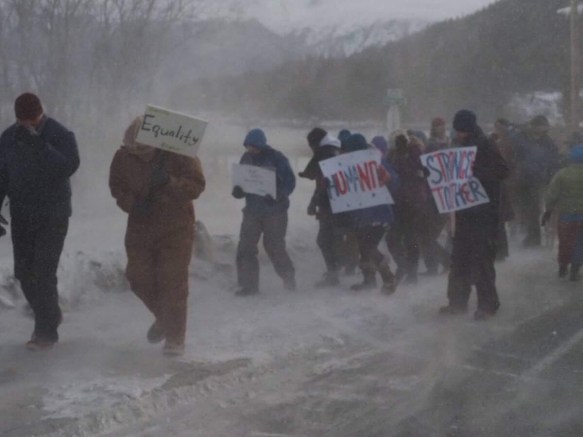



I would like to submit these images for the benefit of my Fox viewing friends who may have missed the news. Without comment.
Immediately following the 2016 election, CNN’s Van Jones traveled to rural Ohio to meet with and interview a family that switched from Obama voters in 2012, to Trump in 2016. His goal was sincere. “I really want to know what the hell happened.”
On the trip out there, the camera crew captured images of rusted out factories that not long ago provided living wage jobs to thriving communities.
The crux of the interview was that this particular family believed Donald Trump’s promise to return jobs to those factories, coupled with not being big fans of Hillary, they decided to switch. Not uncommon in rural America, a total pocketbook decision.
Trump is less vocal about the Carrier deal these days as layoffs outnumber jobs promised.
The irony here is that Trump’s base consists of generally white, blue collar workers whose livelihood depends on living wage jobs. A recent article by the Brookings Institute asserts that while indeed the economy is adding jobs, the vast majority of them are going to college educated individuals.
The number of Americans with high school degrees or less who are employed, in this 9th year of economic expansion, has fallen by 2,995,000.
I find it odd that virtually everyone is voting against their own economic interests. The college educated demographic voted overwhelmingly for Hillary.
In any case, I’m sorry to inform the Trump voters out there, those factories are just as rusty as ever. The real threat to job loss isn’t immigrants or bad trade deals. It’s automation.
The yoke’s on you.
President Bone Spur seems to be fairly indifferent to optics. Witness his unending golf trips at his private clubs.
I can only imagine Mitch McConnell this morning, munching on his poached egg and toast, wondering if Trump is going to provide commercials for every democratic candidate tonight by prancing around Mar-a-Lago to a $100,000 a plate affair celebrating a year in office.
Regarding DACA: I cancel it, you fix it.
I’m not fond of working weekends either, Mitch. It kinda sucks. But you have to play the hand you’re dealt.
The U.S. government is going to shut down in an hour and 5 minutes.
While I hate to see the inconvenience this will impose on hundreds of thousands of federal workers and contractors, I applaud Chuck Schumer for taking a principled stand. The republicans have worked themselves into a corner where they have absolutely no credibility with respect to a promissory note to fix important issues later. Schumer and the democrats recognized that it’s now or never.
With the ensuing chaos that will start tomorrow morning where Dick Mulveyney will need to decide what stays open and what closes, there exists a clear inconvenience to republicans to come to the table and negotiate. Trump might have to postpone a golf game or two. The party celebrating the one year anniversary of his inauguration is in jeopardy. It’ll be interesting to see if he holds it. It would be incredibly bad optics.
Schumer played this poker hand pretty well this time. Basically called republicans’ bluff that Dems would take the heat for a shut-down. On the contrary.
If he’s able to negotiate a deal for the Dreamers and get funding for CHIP, he’ll have accomplished two things. One, his principled stand will get looked at as what resolved the Dreamers issue. Two, he will have established credibility that democrats are willing to call McConnell’s bluff if they feel like public opinion is on their side. These are two very important accomplishments that need to happen in order to fix the ‘tude problem on the other side of the aisle.
I’m reminded of a funny story I was told by local musician, producer, singer, songwriter Jim Walker a few years ago. One day we got off on the topic of people who, with no talent of their own, like to sit there and launch criticisms of bands and how they suck or whatever.
So as the story goes, Jim and a friend were at a bar watching a local band and there happened to be an obnoxious guy standing behind him who kept making rude comments about the band and how they sucked. You can only ignore someone like that for so long. Evidently Jim’s friend had had enough of this guy, turned around and asked him “Where’s your song, man?” I guess he got a lot more quiet after that.
I’m reminded of this humorous episode as I watch Republican infighting over the DACA solution. It’s humorous for a couple of reasons. First, Lindsay Graham tries to be Trump’s buddy and get into his inner circle by going golfing with him and flattering him afterwards. Then he makes what I would say is a good faith effort to work with democratic senator Dick Durbin on a bipartisan solution to DACA. Does the President want to hear about it? Sure, c’mon over.
To his surprise, Trump had invited a few of his hardliners to the meeting as well. Graham’s idea got shot down by Cotton and Perdue who have no intention of working in a bipartisan fashion with any democrat, even though 80% of U.S. citizens want to see a solution for Dreamers. So Graham is out there strumming his tune, laying out his proposal and Trump gets indignant about it complete with shithole comments.
But as bad and racist as that was, that’s not the point here. The point is, okay, you don’t like my plan. Where’s yours?
So, Senators Cotton and Perdue. Where’s your song, man?
Yesterday a Chinese credit rating agency downgraded the U.S. credit rating over “political deficiencies”.
It’s worth noting that this occurred prior to any government shutdown. A shutdown will of course further reduce the U.S. credit rating and likely have an immediate impact on interest rates.
I believe this is a case where the minority party actually has a better poker hand than the majority. 80% of Americans want the DACA issue settled. The question then becomes “who looks worse if the Dems take a stand on Dreamers and government shuts down?”
I think Republicans will take the hit.
The question is then, do Democrats have the cajones to risk public opinion on a shutdown? I’m not convinced they do. However, it would be a historic stand and the right thing to do. 3 days to find out. My money is on kick the can down the road on a short term resolution.
It’s hard to decide some days in which form to participate in the #resistance. For the most part, with Facebook and Twitter we’re preaching to the choir without having any real impact.
After some consideration, I feel like getting involved with voter registration efforts is probably the best use of time. My help isn’t needed in Portland though. I’ve seriously considered a trip to Wisconsin to support Randy Bryce because Paul Ryan must be defeated. But I have equal disdain for Kevin McCarthy, Ted Cruz, Chuck Grassley and Tom Cotton so it’s a tough call.
Focusing on house races is more important than Senate races. It’s unlikely the math is there for a takeover of the upper chamber.
Recently I came across an innovative idea from a guy I follow on Twitter, Claude Taylor. He’s buying up billboard space to “oppose all the Trump boot lickers.”
It’s an official PAC and they are starting the roll out any day now. The first one will be in Florida off if I-75, It’s also worth noting, Three Billboards outside Ebbing, Missouri won the Golden Globe for best picture.
I like the idea so much I sent the PAC some money. The combination of voter registration and public shaming sounds like the ticket.
It’s not what you think.
We have to hope that the procrastination of the Hanford cleanup doesn’t kill us all. Our home values would be the least of our concerns.
It’s really true there’s no free lunch. Yes, the United States beat Russia in the race to develop the first nuclear bomb. There are many books on the subject and The Manhattan Project was one of the most ambitious undertakings in the 240 year history of this country in size and scale.
The downside is, we’ve been trying to clean up the site for over 70 years and are nowhere near complete. Current estimates are $2 billion per year until cleanup is complete in 2050.
There are 53 million gallons of radioactive waste in stored in 177 underground tanks. One third of these tanks are leaking radioactive waste into the soil and groundwater. Aquifers are containing 270 billion gallons of contaminated groundwater. As of 2008, 1 million gallons of radioactive waste was traveling through the groundwater toward the Columbia River.
I don’t know about you, but that makes me lean towards Alaskan Salmon at the seafood counter.
From a recent article comparing the risk of Hanford to what happened in Fukushima, Japan.
On 29 September 1957 a tank containing waste similar to the waste in the Hanford Tank Farms exploded at the Mayak plutonium production site in the former Soviet Union, known as the Kyshtym Disaster. The cooling system for one of the tanks at the Mayak site failed and the temperature inside the tank rose eventually causing a chemical explosion that sent a radioactive cloud for over 350 km downwind and heavily contaminated an area near the plant with catastrophic levels of cesium-137 and strontium-90. This was one of the worst radiological disasters in human history at the time, and remained so, along with the fire three weeks later inside a nuclear reactor core at the Windscale facility (now called Sellafield) in Cumbria in the United Kingdom, until the Chernobyl meltdown and explosion in 1987. The Kyshtym Disaster, which a Soviet study concluded resulted directly in 8,000 deaths (not to mention illnesses) was the consequence of an explosion in one tank. At Hanford there are currently 177 such tanks, each containing similar disastrous potential, and located beside one another.
If you do the math on the population of people downwind, all I can say is we’d better hope those cooling systems continue to work or this place will be uninhabitable for a century. And that’s just one scenario.
I’m anxiously awaiting the Trump administration to roll out its infrastructure plan. Rumor has it a small, private outfit in Montana with connections to Ivanka Trump’s wedding planner will be put in charge of the cleanup. If that happens, I’m moving.
In 2003, a documentary titled The Fog of War: Eleven Lessons from the life of Robert S. McNamara was introduced. Here’s a link to a 2 minute trailer on it.
The reason this movie comes to the forefront of my mind these days has to do with the banter going back and forth between the U.S. and North Korea and Iran.
In the movie itself, McNamara was interviewed where he talked about the discussions of the Kennedy administration cabinet, strategizing around the Cuban Missile Crisis. The most revealing aspect of the interview was the fact that much of the strategy conversations had to do with ‘guessing’ at what Russia and Cuba were thinking. What their motives were. They didn’t know for sure so they had to guess.
McNamara’s point was, had they guessed wrong, they could have a nuclear event on their hands that was a result of a big misunderstanding. It was entirely possible for this to happen. He strongly emphasized the need for diplomacy so that any events centered around war were fully understood and not the result of second guessing wrong.
This is perhaps the scariest aspect of the Trump Administration for me. The probability that he will initiate military action based on his impulses without a full understanding seems extraordinarily high. This is why level-headedness matters in the oval office.
It looks to me like the movie is available from Netflix but on DVD only. There may well be other streaming sources. If you get a chance to see it, I found it very enlightening.
Below is a summary of the 11 lessons from McNamara.
This blog post is actually about counseling. In no way am I an expert, but after 12 years as a client, I feel somewhat qualified to make a few comments on the subject.
I don’t intend to go into my personal life or the personal lives of family members, but I think I can share a few nuggets of wisdom that I learned along the way.
In retrospect I see my divorce in 2008 as a win-win. She’s met someone who I like a lot and I think is a perfect match for her. I’ve done the same. It was really tough but after 27 years we had to face it. It wasn’t working. We got married too young. We are different people at the core. We’re human and humans make mistakes. We consider ourselves lucky in that this one turned out pretty good for everyone.
15 years into the marriage we entered counseling. In the process I feel a little bit like the blind man who had surgery and was suddenly able to see. There were a few aha moments that changed my life for the better. For that, I have very grateful.
One of them had to do with people connections. Not just acquaintances, real people connections. One day you’re thinking that you’ve got it all going pretty smooth. Shoot you’re the Vice President of Little League Baseball. You’re a manager at a high tech company. Everyone knows you. Next you realize your life consists of mostly acquaintances where you’re not really connected on a deep level in any way at home or at work. That one was hard. Very hard. Life changing.
Another one was humility. She was just so gentle with the message too. I don’t even recall what I was talking about at the time but she interrupted me and asked “Where’s the humility in that?” In the moment I was taken aback. I couldn’t answer. It didn’t make any sense. I was brought up to see the value in humility and if anything, my parents’ capabilities and intelligence were understated. Where did I go wrong? I think I know the answer and it’s not really important to this blog post, but be that as it may, I learned a dose of humility goes a long way and have tried to be a different person ever since.
When someone figures you out at a deep level like this, I think there’s a danger of elevating their words to a level that’s not healthy. They are just humans too. They make mistakes. But somewhere along the way I became more of a disciple than a client. And in her own way she recognized this and corrected that line of thinking too.
Basically what she said was, “Don’t give me that power. I don’t know everything. You don’t need me anymore. You can do this yourself. It’s all in here.” And then she put her fist over her heart.
Truth be told, I think I wanted the dependency at the time. But she was spot on. It is in there. We don’t need to give up our power to other people who are the experts. They are just people. Sometimes (not always) what we need to do is to dig deep.
Counseling is a tricky business. I’ve talked to several. Only 1 or 2 have made a difference so it can be hit and miss. It’s one of those things where you really have to go with your gut. I can attest to life changing moments that were worth every penny. I can also attest to at least a dozen appointments that were a complete waste of time and money.
I can also say that there’s something to be said for just manning up and owning your own stuff and not looking outside for guidance. You can’t buy your way out of it. How do I know this? Because I learned the hard way.
My takeaways? You can’t take it with you. People don’t care what titles you hold. Live in the moment as much as possible. Enjoy your friends and family while you can. And don’t get too big of a head on your shoulders. When we reveal our humanness with our flaws and all, people are actually drawn to that more.
My $.0.2
 View from my PDX Window