George Carlin once said the answer to world peace is an international square dance every Friday night. Think about it. I can’t shoot Igor, he was at the dance yesterday and he’s a cool guy!
I do not see a counterargument that would work very well.


George Carlin once said the answer to world peace is an international square dance every Friday night. Think about it. I can’t shoot Igor, he was at the dance yesterday and he’s a cool guy!
I do not see a counterargument that would work very well.
What should be our mindset when we open the Bible? How did these books come into being? This is a core question that isn’t often addressed. What other essential questions must we ask ourselves about our belief in Biblical texts?
Most folks don’t think very hard about using the phrase “the Bible.” We often assume we’re communicating with people who already agree with us about what “the Bible” is, but that’s not always the case. Scholars hold that there is no single Bible because the Bible as we know it today is a collection of texts written by more than one hundred authors and as many or more editors who wrote, edited, and compiled the Bible in three different languages across two continents over the course of eleven centuries. The Bible is the result of a compilation process — and there have been many compilations.
In the 21st Century, the most popular translations include, but are not limited to, the King James Version (KJV), the New International Version (NIV), the English Standard Version (ESV), the New Living Translation (NLT), and the New American Standard Bible (NASB). These versions trade off readability and fidelity to the original texts to appeal to different audiences with varying goals when reading the Bible.
Inspiration, Inerrancy, and Univocality
My starting point is to ask three relevant questions. 1) Is the Bible the inspired word of God? 2) Are biblical texts inerrant? 3) Do Biblical texts speak with one single, unified, and consistent voice and from one single, unified, and consistent perspective?
Since no supporting data exists for any of these beliefs, they can only be asserted. In a discussion about what the Bible says, those assertions can mean anything only if the participants agree to grant them that authority.
While the Bible can occasionally be used as a historical document, it contains many gaps. Some suggest that this is where many biblical innovations have been carefully curated to fill gaps in stories lacking critical details. Dan McClellan, a modern-day biblical scholar, strongly advocates interpreting the books of the Bible literarily rather than literally, considering the author’s rhetorical goals. He offers the following explanation:
“Every last word of the bible is a piece of literature, meaning a human author wrote it down with a specific literary genre or combination of genres or innovations on literary genres in mind using conventions and idioms and allusions to try to draw out their rhetorical goals which usually had more to do with the structure of power, values, or boundaries than with just reporting on an event. And so we don’t do justice to what the authors were trying to convey with their texts when we ignore all that and just imagine how these things would have happened historically. In addition to the fact that that’s not what the authors want you to do with the text. Most of what we have in the Bible has no historical reality behind it. The stories in the bible are overwhelmingly literary creations, so they never existed on anything other than a literary level. So, when we try to create a historical background for what is going on, we are merely making things up, which will not lead us to a better understanding of what the author was trying to convey; it will lead us to a worse understanding. The authors had several objectives in mind when creating the texts, and if we overlook these, we will not have a good chance of understanding what made those texts meaningful and valuable to them. Instead, we will overwhelmingly subordinate the texts to our own rhetorical goals — what we want the text to do for us.” — Dan McClellan
Though not his primary goal, McClellan undermines the foundation of the Church’s basic tenets. Adam, Eve, Abraham, and Isaac are post-biblical innovations, along with the Trinity, Original Sin, the Virgin Birth, and Biblical Inerrancy. McClellan is an educator and, thankfully, an honest voice sharing his knowledge with anyone who will listen without regard to whose feathers might get ruffled.
His opinion appears to be in the minority regarding the views of church leadership, but is he wrong? Or is he a trailblazer? He’s got an enormous following on social media over 1 million followers, and those who challenge him on an intellectual level usually lose badly. Facts matter.

Inspiration
Many Christians believe that Biblical texts were divinely inspired. To quote The Moody Bible Institute:
“We believe that the Bible is God’s Word. Moody Bible Institute’s doctrinal statement affirms, “The Bible, including both the Old and New Testaments, is a divine revelation, the original autographs of which were verbally inspired by the Holy Spirit.”
What are the criteria by which we determine whether any given statement in the Bible is the inspired word of God or not the inspired word of God? Does the Bible claim to be the inspired word of God?
Many point to 2 Timothy 3:16, which says, “All Scripture is God-breathed and is useful for teaching, rebuking, correcting, and training in righteousness,” as definitive proof of biblical inspiration. But can a biblical text point to itself as scripture? Scholars point out that the author was writing in the late first or early second century CE, but they wanted us to believe they were Paul writing in the 50s or 60s CE. They also point out that 2 Timothy 3:16 wasn’t itself understood as scripture by its author. The most likely interpretation is that the author was asserting the life-giving qualities of the scriptures and their utility as rhetorical instruments.
When I think of the term ‘divinely inspired,’ I envision God hovering over an author, dictating exactly what to say. Or maybe he doesn’t hover over the person. Since he’s God, perhaps he simply inserts the exact thoughts into the author’s head before they begin writing, and that takes care of it. Physical presence would not be necessary because with God, all things are possible. In any case, the claim divinely inspired implies with certainty that a text is the word of God. This asserts that “The Bible is divinely inspired” all the more difficult to accept as a true statement. The Bible contains between 66 and 73 books, depending on one’s religious affiliation. This translates to approximately 31,000 verses or roughly 800,000 words. God said all of this through scores of prophets penning scripture for him? Really? That’s seems far-fetched.
The problem for apologists is that the phrase “The Bible is divinely inspired” is binary. It’s either the case that every single text is something God said indirectly, or it’s not. They can’t have it both ways.
Psalm 137 presents a challenge in this regard. The story recounts the Israelites’ sorrow and exile in Babylon. Scholars describe the story as a Revenge Fantasy. Verse 9 is an example of how the Israelites’ bloodlust feelings about being mistreated: “Happy is the one who seizes your infants and dashes them against the rocks.” Apologists claim that, in this case, it’s NOT God speaking. But… I thought you said ….
Numbers 31 and Samuel 15 are also examples where it is indisputable that the God of Israel repeatedly commands the slaughtering of innocents. But… I thought you said …
On the issue of slavery being condoned by the Bible, the books of Leviticus and Exodus condone the practice of slavery. So this is God speaking?
It’s interesting that Church pastors who wrestle with these issues when confronted by their parishioners — their interpretations of the Bible get more nuanced. Of course it does.
Inerrancy
Many of the faithful refer to the Bible as “The single source of truth”, yet it doesn’t take a Rhodes Scholar to find discrepancies that easily squash that assertion. The genealogies of Jesus in Matthew 1 and Luke 3 differ significantly, leading to different chronologies and ancestral lines. The differing resurrection reports in the Gospels (e.g., who arrived first at Jesus’ tomb, what they saw and heard) contain discrepancies. The Biblical age of the earth (6,000 to 10,000 years) conflicts with the consensus scientific view of ~4.5 billion years. There are issues with census counts, timelines, and scientific descriptions (e.g., flat earth) that do not align with modern knowledge.
Biblical texts have been copied and edited over centuries. Variations and errors have been introduced due to the human factor. Cultural biases and perspectives influenced the text. For this to be true, one would have to assert that not only was the original author’s work inspired by God, but God would have also shielded all of the editors and translators from making a single error. Asserting that the Bible is inerrant is a “sweeping statement”, tough to conceive of as being accurate.
Univocality
The Bible encompasses a diverse range of literary genres, cultural contexts, and perspectives, rendering its message complex rather than having a single, definitive interpretation. Since the data points to separate books, written by roughly 40 authors over 1,500 years, from different continents, in languages such as Hebrew, Aramaic, and Greek, along with the thousands of discrepancies contained within the texts, the case for univocality is a significant stretch—hard no on this one.
Ever-changing Biblical Law
At a high level, we began with biblical laws from the Old Testament. The rules of Moses were set in stone until they weren’t. In Acts 15, the Jerusalem council, after they determined that gentile converts to following Jesus didn’t have to obey the law of Moses, they changed it to: 1) Abstaining from sexual immorality, 2) Abstaining from eating things sacrificed to idols, 3) Abstain from the meat of strangled animals, and 4) Abstain from blood. They eliminated the entire law of Moses, except for four things, and three of them were dietary restrictions. Christians today have overwhelmingly rejected any kind of dietary restrictions because it doesn’t matter what the Bible says. It only matters what we say. We negotiated with the texts to get out of that one.
Every single existing law was abolished with the New Covenant, which completely replaced the Mosaic law and focused on loving God and Neighbor, Embracing grace and living righteous lives with humility, compassion, and forgiveness. If this were the endpoint, it would have been nice just to start here and not have to pay attention to all the other confusing laws. I’ve always wondered why the Ten Commandments are posted in the classroom. They no longer apply. If we must have some religious moral guidance, why wouldn’t Christians want to insist on the laws from the New Covenant instead?
Conclusion
Regardless of your beliefs on these questions, a healthy dose of skepticism is warranted regarding how people have interpreted biblical texts to suit their own goals. Those who assert that “God’s word never changes” fail to acknowledge that the Bible has changed over the past 2,000 years. Books were added, removed, rewritten, and mistranslated. If the Bible never changed, then which version are we talking about? The Bible also contains a variety of contradictory laws and laws that were later superseded or altered. Trying to make sense out of which commandments are relevant today, we have no choice but to rely on whatever religious hierarchical system we belong to to make a final interpretation, and then impose that interpretation on biblical texts. This is to help us identify which commandments we will prioritize, which we will reinterpret, and which we will declare no longer relevant.
The big question is, are these books holy and divinely inspired, containing a mandate of obedience, or not? Or are they man-made books, a simple accumulation of fragments and myths? If they are divine, how are we to escape their injunctions, such as “Thou shalt not suffer a witch to live.” What are we to do? God is saying Kill all witches.
We collectively overrule the Bible’s approval of slavery. There’s not a single syllable of the Bible that identifies the practice of buying, selling, and owning other human beings as a sin, but we identify slavery as wrong today. Why? Because we decided to overrule the Bible on that. The Bible was the authority on slavery until we decided that what we learned from Greek philosophy, the renaissance, the reformation, and the enlightenment were important lessons.
Similar shifts have taken place to different degrees over the centuries related to things like polygamy and celibacy. The Bible only has authority to the degree we grant it authority by way of consensus.
When we engage with biblical texts (which have no inherent meaning), we negotiate with them, and that determines what meaning they ultimately have for us. Whether we realize it or not, our opinions heavily influence the outcome. The unfortunate part of this is that some appeal to the Bible to baptize their opinion to endow it with God’s authority.
I am more comfortable being in alignment with those who seek to understand the Bible as its authors, editors, and earliest audiences understood it. Wouldn’t it be refreshing to be intellectually honest and acknowledge that the Bible condones and even endorses actions and behaviors that are widely agreed today to be harmful, hateful, or otherwise just wrong? Doing so doesn’t undermine or otherwise disparage or take away from the profoundness of the Sermon on the Mount, or Matthew 7:12, or 1 Peter 4:8, or Ephesians 4:32 which address love, compassion, and doing unto others.
Not if the Bible is viewed for what it truly is — a collection of texts written by over 40 authors with different agendas for different target audiences.
As a general rule, once we separate from the notion of a divinely inspired, inerrant book that speaks with univocality, we can realize that the Bible doesn’t tell us what to do; we tell the Bible what to do. We grant it authority based on our social and historical circumstances, as well as our identity politics, needs, and goals.
In my upcoming book “It’s Complicated, Isn’t It?”, there’s a chapter on Religion and Politics where I delve into the absurd positions that “Christian Right” Republicans hold on immigrants, trickle-down economics, the social safety net, and guns. With the news of Catholic Cardinals casting their ballots for Cardinal Robert Provost to be the next Pope, the same group of Republicans are losing their minds. Oh great, now we have a “woke” Pope.
Republicans have been faced with the challenge of twisting the messages from the New Testament to fit their caste system for decades now, and the election of Pope Leo XIV is going to make it considerably harder.
Contrast these two points of view.
You love your family, and then you love your neighbor, and then you love your community, and then you love your fellow citizens in your own country, and then, after that, you can focus and prioritize the rest of the world.
— JD Vance (A Catholic) on Fox News
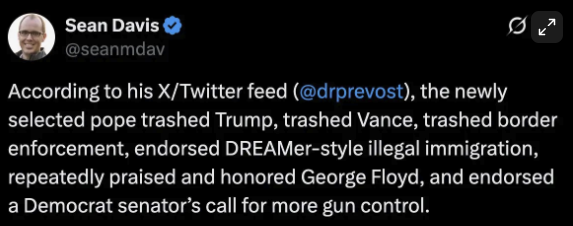
Republicans using gymnastics to twist the message of Love Thy Neighbor is nothing new. We’ve been witnessing Olympic Champion levels of deceit in the halls of Congress for decades, but this is potentially a powder keg of anti-Trump messaging waiting to happen. And I am here for it.
On Thursday, I attended Dan McClellan’s book signing event at the Duniway Hotel in Portland. If you are unfamiliar with McClellan, he is a biblical scholar with a Ph.D. from the University of Exeter in Theology and Religion and a robust social media following (Twitter, Instagram, et al.). He also co-hosts a podcast called “Data over Dogma” with Dan Beecher.
McClellan is a somewhat controversial figure in religious circles because he frequently and unapologetically discredits religious myths and dogma posited by the far right. He does this very unemotionally and intelligently, presenting irrefutable facts and scholarly research to the conversation. Watching him in action has been both educational and entertaining.
Dan’s new book is titled “The Bible Says So — What We Get Right (and Wrong) about The Bible’s Most Controversial Issues,” The book delves into provocative subjects such as whether or not the Bible is the inspired word of God, its inerrancy, Creation, Slavery, the Trinity, the Virgin Birth, and whether or not the Bible says women need to cover up. True biblical scholars like McClellan add historical, cultural, literary, linguistic, and theological context to the conversation. In doing so, he tries to understand Biblical Texts as their authors, editors, and earliest audiences understood them. From McClellan’s introduction:
Many people approach the Bible as authoritative, maintaining boundaries regarding what it is and isn’t allowed to say. Allowing the Bible to transgress those boundaries can raise doubts regarding deeply held beliefs people don’t want to see subjected to scrutiny. They are not beliefs that people adopt because they’ve been convinced by data or evidence. They’re beliefs that people choose to accept because doing so is required or incentivized within the social identities that are important to them. Sometimes these beliefs are supported by data and sometimes they are not, but what is true of all of them is that they’re not negotiable. I call this type of belief dogma.
McClellan’s presence on social media frequently intersects with people who assert dogmas such as biblical texts as divinely inspired, inerrancy, and univocality. You’d have to read the book to get all the details, but in a nutshell, McClellan rejects these assertions. He asserts that these beliefs arose over time as people contemplated the implications of different approaches to the Bible and constructed perspectives that made the scripture most useful to their structuring of power, values, and boundaries.
Perhaps the most eye-opening takeaway from McClellan’s message is from a linguistics perspective — that the Bible is a collection of texts without inherent meaning. Meaning comes into play when we attempt to interpret the text, so at the end of the day, it’s whatever you make of it based on your own experiences. We are never just extracting pure and unadulterated meaning. We’re continually constructing it ourselves. We end up guessing the original authors’ needs, circumstances, values, and goals. Why? Because the needs, circumstances, values, and goals of authors and editors two thousand years ago are wildly different than those of today.
My interest in these topics stems from the fact that I am writing a book myself, “It’s Complicated, Isn’t It?” For most of my adult life, I’ve been interested in engaging in discussions with others (if it can be done intelligently and unemotionally). It’s a frustrating endeavor because, in the age of social media, you’re more likely to run into people so steeped in misinformation that they instantly refute your point with lies and propaganda. There’s no moment to pause and stop to actually think things over. They just immediately pull out some parrotted talking points as a rebuttal (usually half way through your sentence). I’ve taken on Republicans in debate forums where Biblical quotes are weaponized in many different ways. In the twenty first century social media landscape, I appreciate guys like McClellan who are out there pushing back on misinformation in an educated way.
I briefly met Dr. McClellan at the book signing and later followed up with a question about the origins of ethics and morals. I was delighted to have him confirm one of the basic hypotheses of my book—believing that ethics and morals originated from the Bible is a fallacy. Ancient philosophers contributed more to framing ethics and morals than the Bible. Most early Christian ethics writing was based on Greek philosophy anyway when the Bible was translated from Aramaic to Greek in 200 – 250 BCE.
It feels good to get validated once in a while.
 View from my PDX Window