
(This was an article I wrote in 2007 if memory serves. The Tualatin times afforded me the opportunity to write a piece for their Living Section and this article was featured).
Sometimes a last name isn’t necessary — Elvis, Elton, Jimi, Mick.
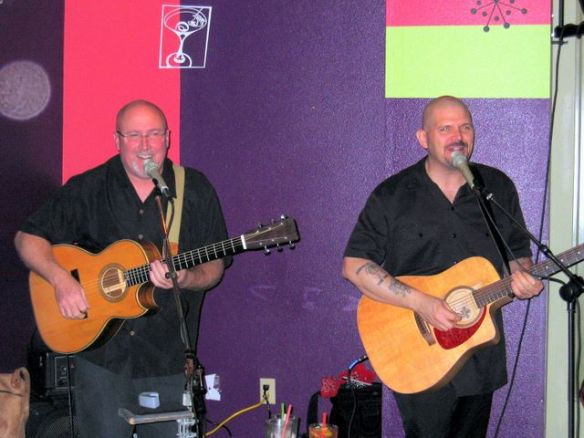
Around Tualatin, the phrase “Tim and Jim” is synonymous with local legends Tim Ellis and Jim Walker, who bring their unique style of entertainment to Hayden’s Lakefront Grill Lounge most Friday and Saturday nights.
On the surface, the idea of an acoustic guitar duo in a hotel lounge may not conjure up images of an evening you’ll want to immediately go text your friends about, but Ellis and Walker are anything but your typical lounge lizard act. They have branded their own style of performance.
It would be hard to categorize their eclectic range of material into a single genre. From Irish Folk Ballads to Simon and Garfunkel, Led Zeppelin to The Beatles’ “Helter Skelter”, they’ve got the bases covered. “Versatility has always been important to us” explains Ellis.
What’s different about Ellis and Walker is the improvisational aspect of the performance. “There is no setlist”, said Ellis. “Everything is very dynamic.”
They are likely to start a marathon medley of songs at 7:30pm and not come up for air until 10pm. As if joined at the hip, they execute seamless song transitions with little more than a head nod or a whisper.
“It’s a balanced attack on chaos”, added Walker. If we’re in a particular rhythm, one of us will think of a song that will either maintain the flow or at least be in a similar key.”
Whatever the formula, it appears to be working. The energy coming from the stage is utterly contagious.
In the greater Portland area journeymen, Ellis and Walker need no introduction. Both have well-established careers in the music business. Ellis has shared the stage with ‘A-List’ performers such as Tom Petty, Robben Ford, and Michael MacDonald. Walker has opened for Little Feat, Karla Bonoff, and Boz Scaggs to name a few.
Considered by his peers to be in that elite class of guitar players, Ellis brings incredible musicianship to the stage and will occasionally take the lead singer role.
Walker is the singer/songwriter of the pair and does most of the lead vocals.
Besides the basic ingredients of impressive musicianship and vocals, Ellis and Walker differentiate themselves from the field with their unique arrangements. When going to see Tim and Jim, expect the unexpected.
Halfway through Loggins and Messina’s “You Need a Man”, they may take a hard left into the signature riff of “Smoke on the Water” which completely catches you off guard, and then return to where they left off on “You Need a Man.” Right about the time you’re saying to the person sitting next to you “Now that was cool”, they do it again, only this time with “Stairway to Heaven.”
It completely disrupts any attempt you were having at a conversation because you feel compelled to pay attention for fear of missing what’s coming next.
Customers appreciate the way Ellis and Walker complement each other. Wayne Wischman, a regular at Haydens who estimates he’s seen Tim and Jim 50 times comments, “The chemistry just works and the sound is great. Jim gets to focus on his strong suit – singing, and Tim gets to let loose with free reign on creative guitar solos.”
Scattered throughout the evening they will perform a smattering of Walker’s originals, which in many cases are just as familiar to the regulars as the cover songs.
Walker’s lyrics are full of imagery. Sometimes dark, at times irreverent, and occasionally humorous, his songs succeed at connecting with a feeling or memory, often bringing back that anti-establishment sentiment from the ’60s.
Explains Walker, “I try to put you in a mood when I write. The imagery is to help my songs be like a cool movie you remember. The irreverence comes from childhood experiences and growing up questioning authority.”
Walker is indifferent to commercial success with his songwriting, though singles like “Empty Emily” and “Feet in my Shoes” are crowd favorites at Hayden’s and have done well by word of mouth and exposure on the Internet.
Ellis stands out as an accomplished guitar player in performance but is perhaps better known around Portland as the guy you go to if you want a top studio musician on your CD. As co-owner of Kung Fu Bakery Recording Studio, he’s well-positioned to tap into his strong suit — recording.
Walker notes, “The best thing about working with Tim in the studio is that he can hear a song once and nail the second guitar part on the first or second take. He has a gift for hear it, play it.”
Ellis frequently records and performs with other well known Portland area musicians such as Craig Carothers, Tom Grant, Mary Kadderly, Michael Allen Harrison, and John Nilsen.
While completely content with what they are doing now, Ellis and Walker confess their dream project would be to get involved with “a cool film with a real budget.” Both grew up in Los Angeles and have connections with the movie industry.
For those who have experienced the cozy confines of Hayden’s, it’s easy to understand why the duo’s popularity creates a bit of a challenge for the staff. The lounge is frequently jam-packed from start to finish on Friday and Saturday evenings.
“Our phones start ringing about Wednesday with calls from customers wondering if Tim and Jim will be performing this weekend”, said General Manager Jeff Munden.
For Walker and Ellis, the appeal is the freedom to be creative in a live setting and the free reign owner Bill Hayden gives them. “It’s very collaborative”, said Ellis. “We work with Bill, not for him. Our interests run parallel. We understand the goal is to provide a great experience for customers.”
Munden points out, “The advantage of Hayden’s is that it provides top talent in the suburbs in a smoke-free environment with no cover charge.”
For local residents, let’s face it we’re spoiled. The talent to play much bigger venues exists.
“I’ve never liked being under the microscope” admits Walker. “Somehow hanging out with big names separates you from the people you really want to be close to.”
“I just want to get up every morning and be excited about what’s on the schedule for today”, added Ellis.
For now, Tualatin area residents can take advantage of some extraordinary live music close to home, but it does beg the question from a familiar Billy Joel tune:
“… they sit at the bar and put bread in my jar
And say, man, what are you doin’ here?”
 View from my PDX Window